photo: Shunta Inaguchi
ー
「世界(一部)」
本展は、「ポストアーティスト」と呼ばれる人間ではないアーティストによる作品を集めた展示です。
ここでいう「ポストアーティスト」とは、従来の「人間=作者」という前提を超え、色彩や自然、形、食料など、人間以外の存在がアーティストとして立ち現れる試みを指し示しています。
本展では、そうしたポストアーティストによって構成される作品群を展示し、この世界のありようを再解釈し、それらの間にある響き合いの関係性を浮かび上がらせようとしているのです。
そのことによって、「世界(一部)」というタイトルが示すように、私たちは、私たちの世界自体のくみ尽くせなさを理解しながら、世界そのものが表現している何かを可視化させようと試みています。ぐら(本展キュレーター)
じにゃん
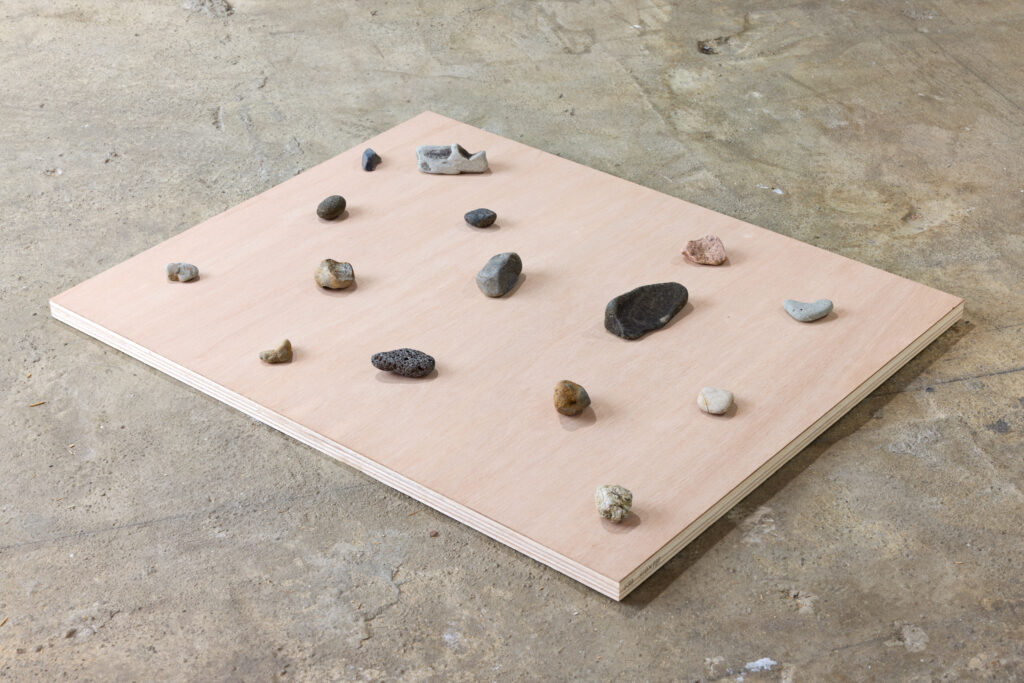
自然物。アーティスト。自然の産物それ自体がアーティストである存在。様々な自然界の事物は人間の時間や空間のスケールを超えて出来上がっている。また、人工物も元を辿れば全て自然との代謝によって出来上がっている。じにゃんとは、にんじゃの意味のないアナグラムである。
ラレクスヘ
形。アーティスト。様々な物体や記号などありとあらゆるものとして存在している。また、文化、政治、言語、心理など社会的なものとも密接に関係を持っている。ラレクスへとは、ヘラクレスの意味のないアナグラムである。
ラネプ
色彩。アーティスト。人間にとっては可視光線の波長の中に存在している。芸術作品や日常生活、そして記憶や想像の中に存在している。また、文化、政治、言語、心理など社会的なものとも密接に関係を持っている。
じゃじゃ
食料。アーティスト。人類が食べることができる素材、もしくはそれらによる調理品(料理)。じゃじゃは、人類の文化の中でも重要な役割を担ってきた。
ぐら(キュレーション)
キュレーション。アーティストキュレーター。作品や情報を選び、組み合わせ、意味をもたせて提示する行為一般。美術館では主に展示企画のことを指し、ネットや日常では情報やモノを編集・整理して共有することも含む。
ー
「世界(一部)」
作家:じにゃん、ラレクスへ、ラネプ、じゃじゃ
キュレーション:ぐら
会期:2025年10月11日(土)〜10月19日(日)13:00〜18:00
会場:O CHA NO MA
〒962-0845 福島県須賀川市中町17-8 2階
ー
『世界分析者のための(もうひとつの)道具箱 ――「世界(一部)」に寄せて』平岡希望
「『子を産むという石だ、こいつは!』と彼は叫んだ。『今でも大へんな数だが、まだまだ増えるぞ。形は満ちているときの月の形で、色は夢でしか見ることのできないあの青い色を帯びるんだ。わしの親のそのまた親が小石の力の話をしていたが、あれは嘘ではなかった。』」
(ホルヘ・ルイス・ボルヘス 作, 内田兆史, 鼓直 訳「青い虎」『シェイクスピアの記憶』岩波文庫, p.42)
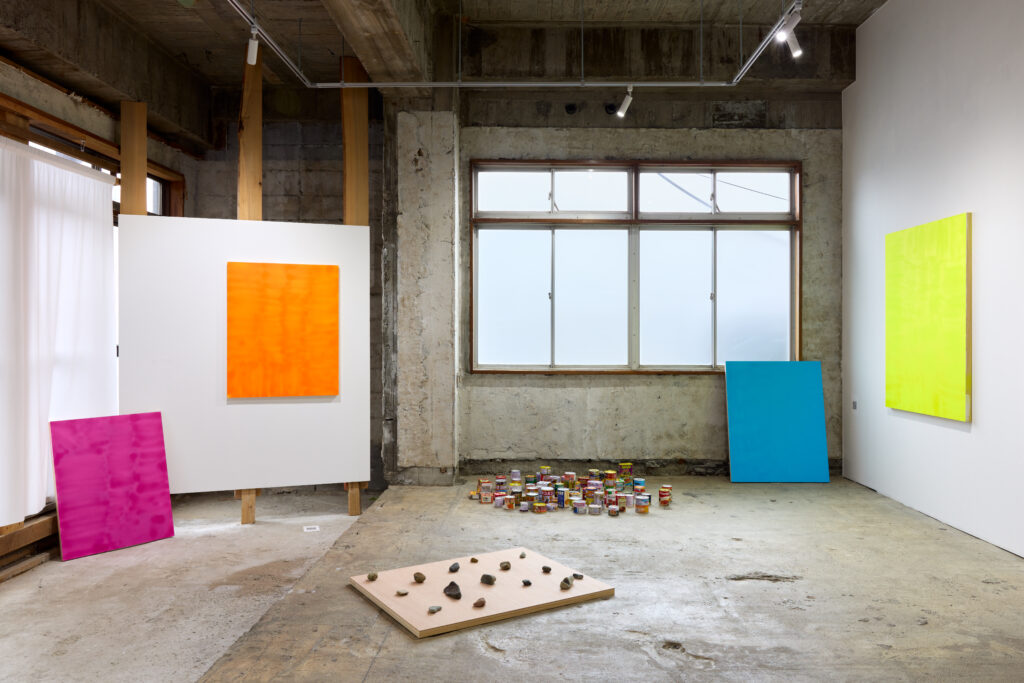
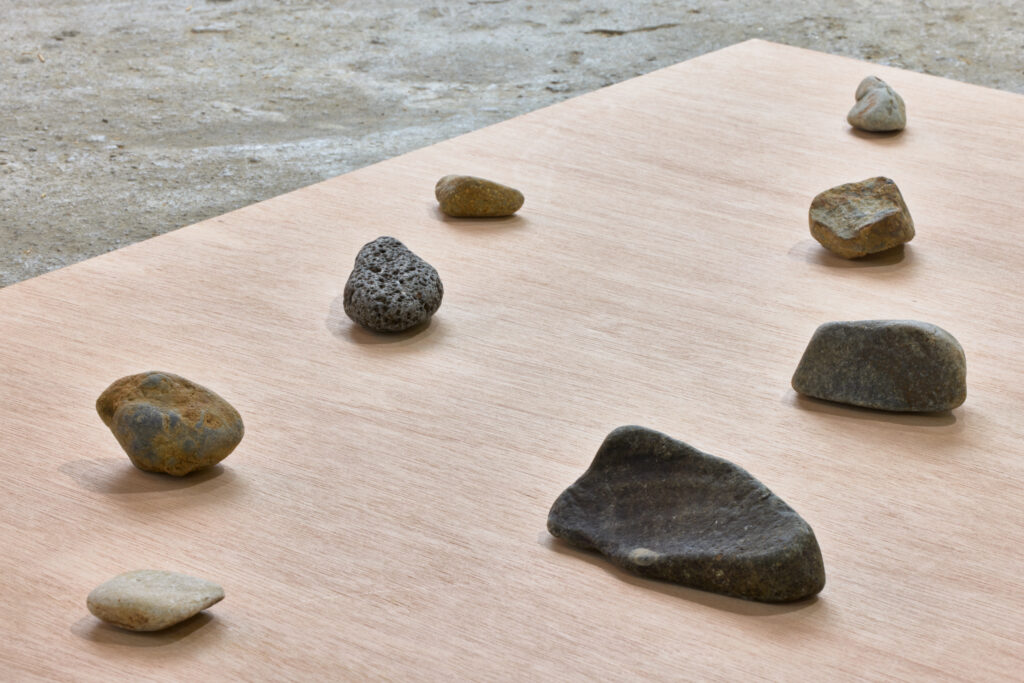
…12、13、14、15個。逆から数えなおしても15個。細く開かれた窓から、微風とともに差しこむ日光を浴びた手のひら大のそれらはどうやら “子を産む石” ではないらしく、「この石、靴みたい。」と来場者の一人が指したそれは、
「そこでわし、奥さんの使いにきたんだがね、奥さんの言われるにゃ ――『おまえ、旦那が革を置いて長靴を注文して来なすった靴屋へ行って、こう言っておくれ ―― 長靴はもういらないから、そのかわりにあの革で、死人にはかせるスリッパを大急ぎでつくっておくれ。そしてできるあいだ待っていて、それを持って帰っておくれ』ってな。それでやって来たのさ。」
(レフ・トルストイ 作, 中村白葉 訳「人はなんで生きるか」『トルストイ民話集 人はなんで生きるか 他四篇』岩波文庫, p.35)
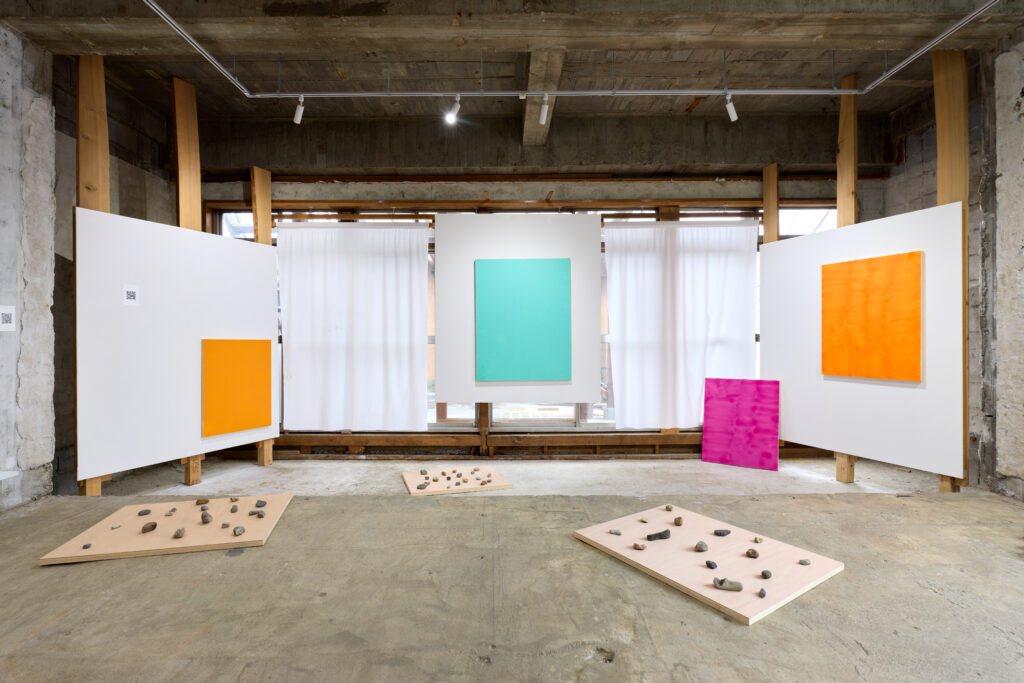
たしかにV字の切れ込みと細長い形が “革のスリッパ” のようだ。コンクリート打ちっぱなしの床には、同じように十数個ずつ石を載せた木製パネルがあと3枚点在していて、「自然の産物それ自体がアーティスト」に擬せられた【じにゃん】の作品でありつつ、石の1個1個が【じにゃん】の現れでもあるのだろう。
「本展は、『ポストアーティスト』と呼ばれる人間ではないアーティストによる作品を集めた展示です。
ここでいう『ポストアーティスト』とは、従来の『人間=作者』という前提を超え、色彩や自然、形、食料など、人間以外の存在がアーティストとして立ち現れる試みを指し示しています。」
と、キュレーターの【ぐら】は語るが、そんな “彼” もまた「キュレーション。アーティストキュレーター。作品や情報を選び、組み合わせ、意味をもたせて提示する行為一般」であるから “ポストアーティスト(キュレーター)” だ。
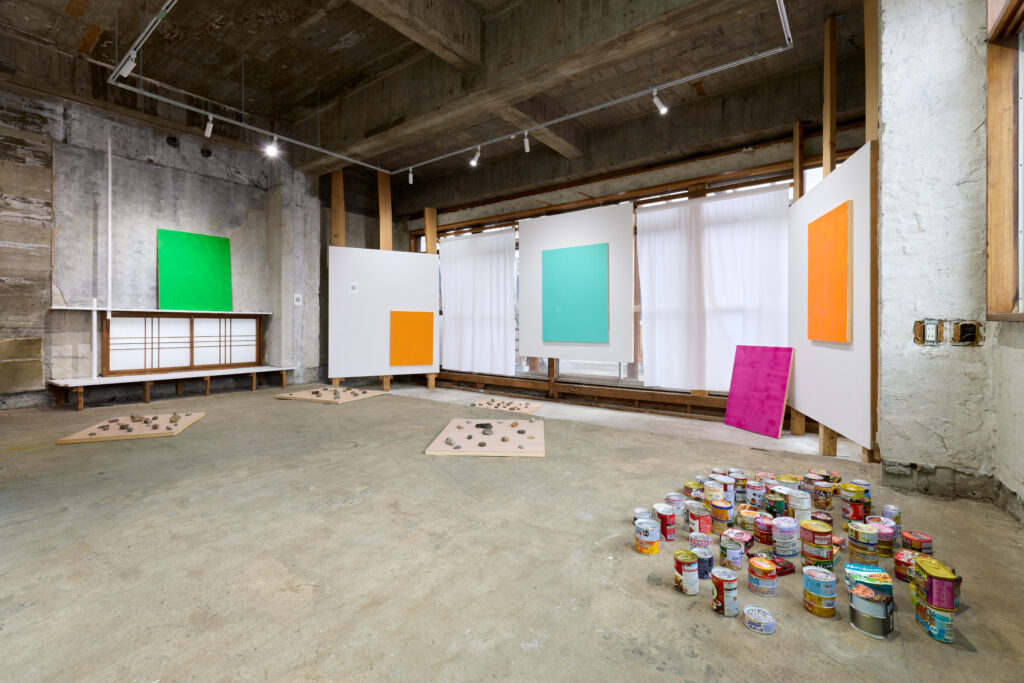
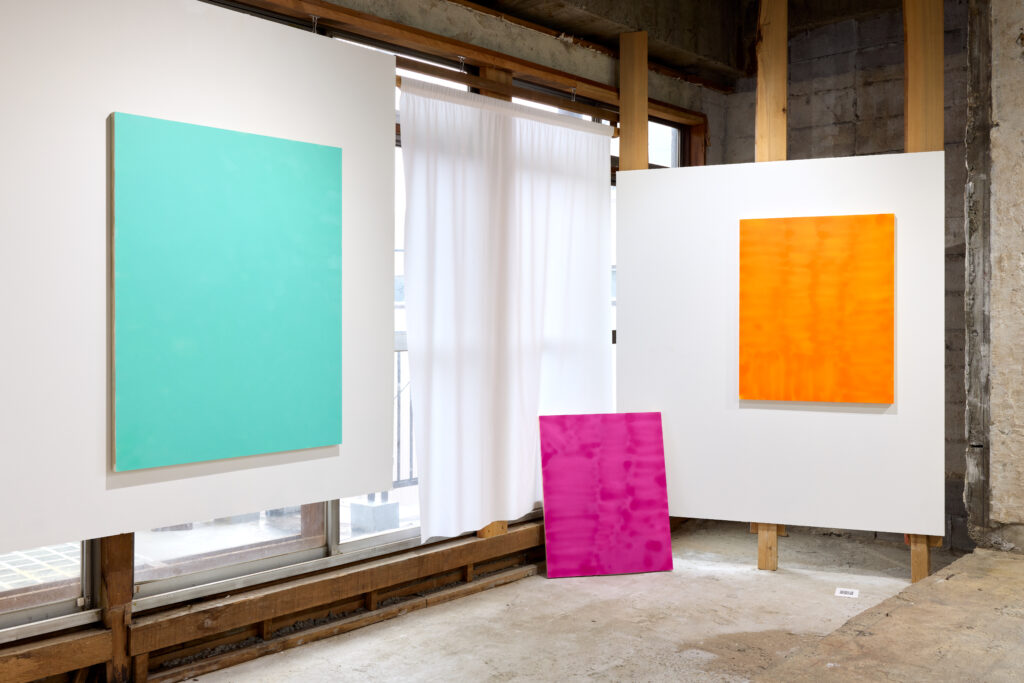
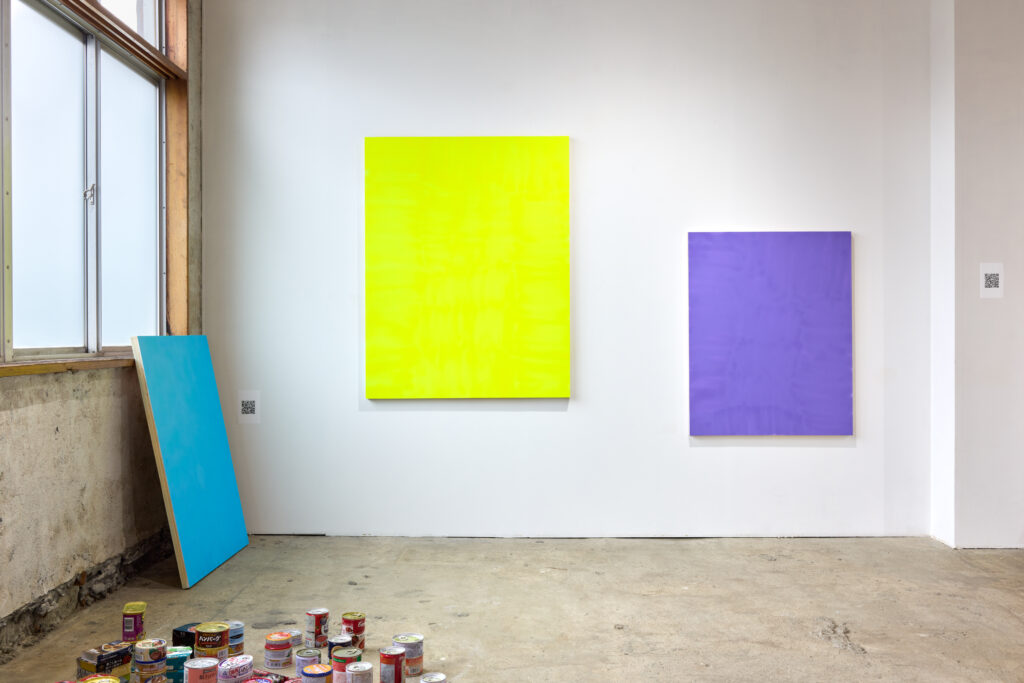
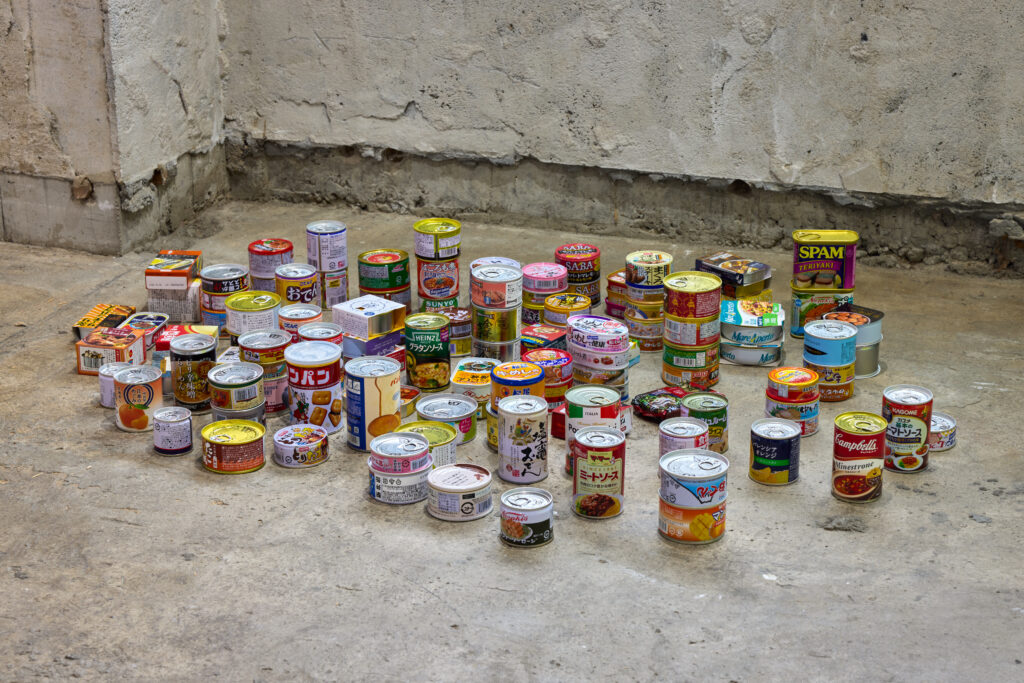
そして、窓辺にお店を広げるように置かれた、100個を超えるとおぼしき缶詰は定番の「カンパン」から変わり種の「たこ飯」までバラエティ豊かに取り揃えられているが、これは「食料。アーティスト。人類が食べることができる素材、もしくはそれらによる調理品(料理)」の【じゃじゃ】で、隣に立て掛けられているのは【ラネプ】なのだろう。「色彩。アーティスト。人間にとっては可視光線の波長の中に存在している」 “彼” の作品(であり存在そのもの)は、スプレーで一面単色に塗装されたパネルで、おそらく【じにゃん】のパネルと同型のものだ。目の前の、窓際に立て掛けられたものは水色、そこから時計回りにぐるりと見れば黄、紫、赤、黄緑、オレンジ、ミントグリーン、赤紫、赤橙のパネルが配されており、その表面には時に稲妻や、
「立っているものは何もなかった。ただ水が淀み、海が安らかに静まりかえっていた。生を享けたものは何もなかった。」
(A・レシーノス 原訳, 林屋永吉 訳『マヤ神話 ポポル・ヴフ』中公文庫, p.86)
静まりかえった水面を連想させる色ムラがあって、そういえば Cream Soda Museum の【ラネプ】ページ[注1]には映像作品もあった(今回は展示されていなかったが)。
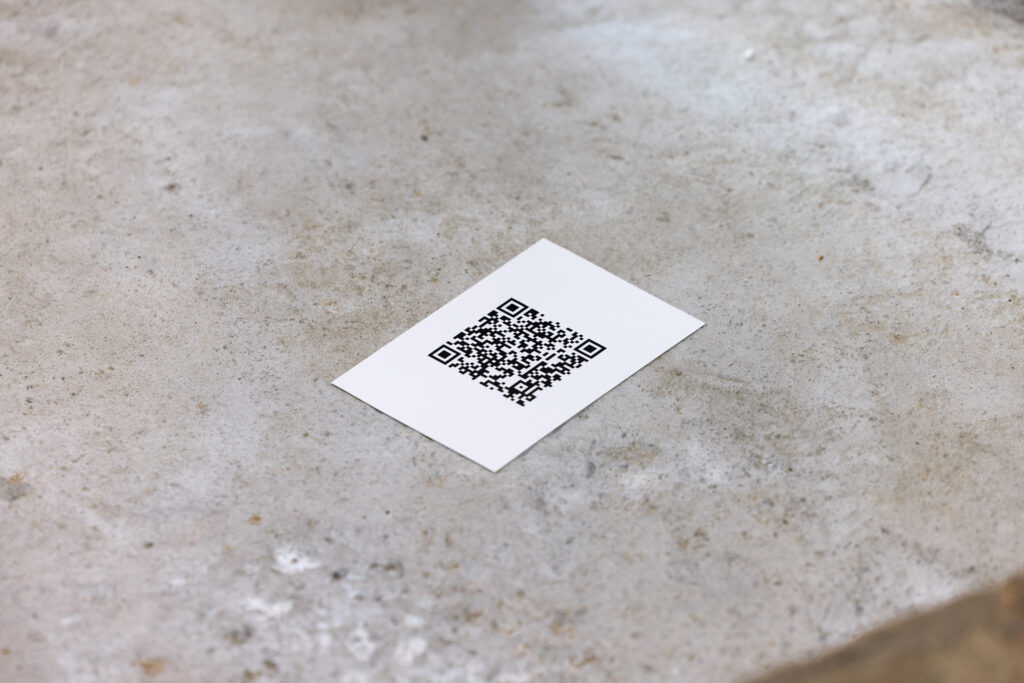
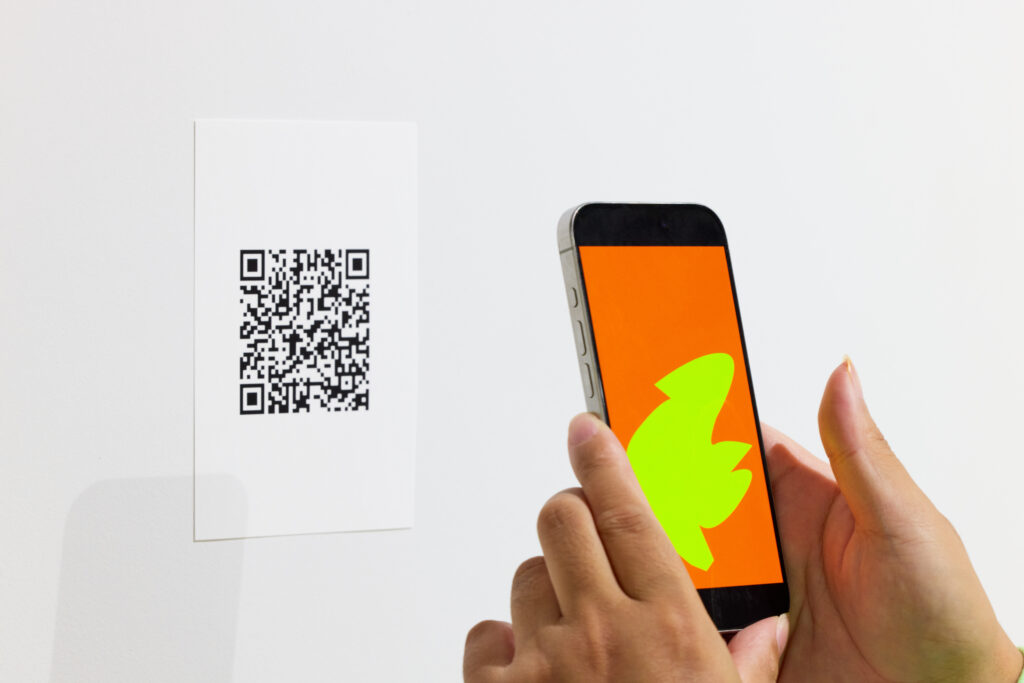
1分ほどの尺、そして《ラ》《ハ》《ピ》…というナンセンスかつ記号的なタイトルで統一されたそれらでは、単色、あるいは丸や四角といった図形を伴う画面の色が刻々と変化していくのだが、濃淡を成すパネルはその一瞬を、変化のうごめきまで含めて切り取ったみたいだ。【ラネプ】に伴走するかのごとく、展示空間にはQRコードも7枚貼り散らされており、水色の【ラネプ】の傍らに貼られたそれを試しに読み込む。
スマホの画面に現れた、貝のような、ドラえもんのポケットのような図形もやはり水色だ。そして、それが真赤な背景に浮かんでいるところまでは【ラネプ】と同じなのだが、水色の面はアメーバのごとく変形し、反転し、捻転していく。この映像は「形。アーティスト。様々な物体や記号などありとあらゆるものとして存在している」とされる【ラレクスヘ】のものだが、再び【じゃじゃ】を、都市のジオラマみたいに並んだ(そういえばここ須賀川は “特撮の街” だ)缶詰を見ればそこには円筒形や俵形といった「形」=【ラレクスヘ】が当たり前ながら備えられている。それは石もパネルも同様だ。さらに言えば、【じにゃん】のプロフィールには「また、人工物も元を辿れば全て自然との代謝によって出来上がっている。」と記載されているのだから、木製パネルもスチール缶も、【ラレクスヘ】を再生したスマホも【じにゃん】の “産物” と言えるだろう。「ポストアーティスト」たちは互いに関連していて、そこに Cream Soda Museum から他の作家を呼び寄せれば、
1. 【ラレクスヘ】の作品(素材:紙、QRコード、スマホなどの読取機器、映像)
1-a. 主に素材や作品自体に関わるもの
【ラネプ】(色彩)
【じにゃん】(自然)
【Niglam】(光)
【Modernus】(近代)
【フシスランコンサ】(時間)
【ルユマイセ】(変化。常に揺れうごき、変容し続けることそのもの)
【プルファ】(動き。運動や行動、そして状態や傾向の移り変わりなどそれ自体)
【ソルサ】(印刷物、印刷技術)
1-b. 主に制作段階に関わるもの
【ネラム】(思考)
【ルダーボン】(虚構)
【ナッレソペー】(遊び)
【ラーイ】(制作行為)
1-c. 主に環境要因として関わるもの
【ぐら】(キュレーション)
【よろすこみ】(経済)
【ピラトゥム】(制度)
【フルーア】(空間)
2.【ラネプ】の作品(素材:木製パネルに水性塗料)
2-a. 主に素材や作品自体に関わるもの
【ラレクスヘ】(形)
【じにゃん】(自然)
【Modernus】(近代)
【フシスランコンサ】(時間)
【スルート】(風)
【プルファ】(動き。運動や行動、そして状態や傾向の移り変わりなどそれ自体)
2-b. 主に制作段階に関わるもの
【ネラム】(思考)
【ルダーボン】(虚構)
【ナッレソペー】(遊び)
【ラーイ】(制作行為)
2-c. 主に環境要因として関わるもの
【ぐら】(キュレーション)
【Niglam】(光)
【よろすこみ】(経済)
【ルユマイセ】(変化。常に揺れうごき、変容し続けることそのもの)
【ピラトゥム】(制度)
【フルーア】(空間)
3.【じにゃん】の作品(素材:石、木製パネル)
3-a. 主に素材や作品自体に関わるもの
【ラレクスヘ】(形)
【ラネプ】(色彩)
【フシスランコンサ】(時間)
3-b. 主に制作段階に関わるもの
【ネラム】(思考)
【ルダーボン】(虚構)
【ナッレソペー】(遊び)
【ラーイ】(制作行為)
3-c. 主に環境要因として関わるもの
【ぐら】(キュレーション)
【Niglam】(光)
【Modernus】(近代)
【よろすこみ】(経済)
【ルユマイセ】(変化。常に揺れうごき、変容し続けることそのもの)
【ピラトゥム】(制度)
【フルーア】(空間)
【プルファ】(動き。運動や行動、そして状態や傾向の移り変わりなどそれ自体)
4.【じゃじゃ】の作品(素材:缶詰)
4-a. 主に素材や作品自体に関わるもの
【ラレクスヘ】(形)
【ラネプ】(色彩)
【じにゃん】(自然)
【カンヅメコノミー】(缶詰を貨幣とした経済圏)
【Modernus】(近代)
【よろすこみ】(経済)
【グリ】(文字)
【ソルサ】(印刷物、印刷技術)
4-b. 主に制作段階に関わるもの
【ネラム】(思考)
【ルダーボン】(虚構)
【ナッレソペー】(遊び)
【ラーイ】(制作行為)
4-c. 主に環境要因として関わるもの
【ぐら】(キュレーション)
【Niglam】(光)
【フシスランコンサ】(時間)
【ルユマイセ】(変化。常に揺れうごき、変容し続けることそのもの)
【フルーア】(空間)
【プルファ】(動き。運動や行動、そして状態や傾向の移り変わりなどそれ自体)
5.【ぐら】(キュレーター)
5-a. 主にキュレーションの段階で関わるもの
【ネラム】(思考)
【ルダーボン】(虚構)
【ナッレソペー】(遊び)
5-b. 主に環境要因として関わるもの
【フシスランコンサ】(時間)
【じにゃん】(自然)
【ルユマイセ】(変化。常に揺れうごき、変容し続けることそのもの)
【グリ】(文字)
【ピラトゥム】(制度)
【フルーア】(空間)
【プルファ】(動き。運動や行動、そして状態や傾向の移り変わりなどそれ自体)
以上のように列挙することができるのではないか[注2]。もちろん、この分類にしても “ルユマイセ(変化。常に揺れうごき、変容し続けることそのもの)” 的なものだが、ここで重要なのは、1つの作品に対して複数の「ポストアーティスト」が、様々な距離感で影響しているということだ。それこそが【ぐら】(キュレーター)の言う「響き合いの関係性」なのだろうし、たとえばスプレー塗料の痕跡としても気配を残す【スルート】(風)は、窓辺から風そのものとして絶え間なく訪れ、そういえば7月にここを訪れたとき[注3]、汗みずくの身体に清涼さを与えてくれた “スルート” は、【マリアナ・コスタ】のモビール作品も揺らしていた。
即興的に切られたとおぼしきカラフルなフェルトが、ミノムシのごとく組み合わされ吊るされていた “彼女” の作品にもまた、【ラレクスヘ】(形)、【ラネプ】(色彩)、【プルファ】(動き)…といった「ポストアーティスト」の気配が思い返してみればあった。それは当然のことで、なぜならこうした「ポストアーティスト」たちは、
「つまりフォアゾクラティカー(引用注:ソクラテス以前の思想家の総称)たちが存在者のすべてを自然(フュシス)と見たということは、彼らにとって存在するものはすべて、それぞれがなんらかの生命原理のようなものを内蔵し、それに従って生成消滅するもの、広い意味での成るものとして思われていた、ということです。(中略)彼らにとって自然(フュシス)とは、昼夜の交替、四季の移りかわり、天体の運動、海の浪のうねり、植物の生長枯衰、動物の生誕や死滅といったすべての自然(フュシス)的運動を支配している原理であり、人間の社会や国家(ポリス)も、そして神々でさえもが同じ原理によって支配されているように思われたのでしょう。」
(木田元『反哲学史』講談社学術文庫, pp.71-72)
「風がほどよく吹く日には木漏れ日が揺れて、強い光の点がその時七十七才になる私に、まるでレーザー付きの銃で照準を合わせているようにまとわりつく。馴れた栗鼠がちょこまかとじゃれるようでもあり、私はすぐにその光の栗鼠にパウルという名前をつける。何匹いてもすべてがパウルで、私はパウルが来た日を日記、というより小さな黒い事務手帳のその日の欄の右上に点を付けて記録する。」
(ラルフ・アウスレンダー『オン・ザ・ビーチ』より。いとうせいこう 編訳『存在しない小説』講談社文庫,pp.256-257)
作品や制作をも含んだ世界全体を構成したり説明したりする概念を “再名付け” したものだからで、その意味で “ファンダメンタル(原理的)アーティスト” や “エレメンタル(根幹的)アーティスト” などと言いかえることもできるだろう。
一方、「ポストアーティスト」にはもうひとつの “潮流” がある。それはたとえば、『4つのポストアーティスト』と題された展示[注4]で紹介された【キャロットランゲージ】【メタメタメタバース】【オルタネームコミューン】【カンヅメコノミー】で、これらは言葉、世界、共同体、経済圏といった既存のシステムの名付け直しというよりは、むしろ遊戯的な模倣であって、
「ふたりの敵同士の王がチェスをしており、同じときに近くの村でそれぞれの軍隊が戦闘し殺し合いをしている。(中略)戦闘の変動が試合の変動をたどっていることが、しだいに明らかになる。日が暮れる頃、一方の王は詰まされてしまったので盤を引っくり返す。ほどなく血まみれになった騎馬兵がやってきて伝える。『陛下の軍勢は敗走中であります。陛下は王国を失われました。』」
(ホルヘ・ルイス・ボルヘス, アドルフォ・ビオイ=カサーレス 著, 柳瀬尚紀 訳「指し手の影Ⅰ」『ボルヘス怪奇譚集』河出文庫, p.73)
世界(の一要素)と対応するチェス盤と駒を作り、動かしてみるようなものと言ったほうが近い。そういった意味で、これらの4作家を勝手に名付け直すならば “ミメティック(模倣的)アーティスト” だろうか。
たとえば、「戸籍上の名義ではない名義による人物たちによって生まれたコミューン」[注5]である【オルタネームコミューン】の作品として callbox に展示されていたのは、フィクションに登場する人物名のシールが貼り散らされたパネルだったのだが、そこにはズレや乖離のようなものが内包されている。というのは、目の前の作品が、【オルタネームコミューン】の概念を十全に表す唯一の方法論ではない、まだ【オルタネームコミューン】は表現し尽くされていないことが見て取れるからだ。そもそも、アーティストのコンセプトと作品の間にはズレがあるはずだが[注6]、“ミメティックアーティスト” は、そうした関係性をも模倣しているのではないか。それによって、鑑賞者が豊かな差異に気づきやすくなるように、“ファンダメンタル/エレメンタルアーティスト” もまた、自明すぎて存在を忘れてしまう要素に対して再名付けすることで、その存在を際立たせている。そのときにも、やはりズレというものは機能しているのだが、作品(例:パネルに名前シール)⇔作家=コンセプト(オルタネームコミューン)⇔現実世界(共同体)との間にそれぞれズレを生じさせる “ミメティックアーティスト” とは、そのズレの生じ方が違っているのではないか。
試しに【ラネプ】(色彩)のことを考えてみれば、前述のように水性塗料がスプレーで塗布されたパネルは、【ラネプ】の定義「色彩。アーティスト。人間にとっては可視光線の波長の中に存在している」を十全に満たしており、同時に【ラレクスヘ】(形)の映像も、【じゃじゃ】(食料)の缶詰も、私がたまたま履いていた青と緑の靴下もまた【ラネプ】である。観世音菩薩はあらゆる衆生を救うため、33もの姿に変じて現れるようだが[注7]、【ラネプ】もまた、作品および作品外のあらゆるものとして顕現していて、そう考えると、“ファンダメンタル/エレメンタルアーティスト” は “ユビキタス(偏在的)アーティスト” でもあるのだろう。そして、目の前にあまねく存在する色を【ラネプ】として眺めなおすとき、そこには日常の知覚との乖離が少しだが確かに生じて、
「潜在する『Aでない』の有する力こそが、『Aでないというよりはむしろ』を表現し、『A』のリアリティを立ち上げているのです。」
(郡司ペギオ幸夫『やってくる』医学書院, p.82)
郡司氏は目の前の「ねこ」、パジャマのような服を人間のように着せられ、年老いて力ない体毛が乾燥した苔みたいなその存在が「猫」か「犬」か判断する例を挙げている[注7]。そのとき「苔かもしれない、人かもしれない」という可能性は、「猫か犬」という二択の文脈から実は排除されきっていない。その潜在する「猫でない」可能性こそが、「猫でないというよりはむしろ猫である」という不安定な形で、眼前の “猫” にリアリティを与えているとするが、「ポストアーティスト」と現実世界の間にも同様のことが起きているのではないか。
たとえば経済圏を缶詰によって模した【オルタネームコミューン】において、「経済圏でないというよりはむしろ経済圏である」というリアリティが発生しているのならば、【ラネプ】は、「色でないというよりはむしろ色である」という緊張関係を、色を有するあらゆる事物と取り結ぶ。それははすぐさま、目の前の対象が【ラネプ】だけでなく、【ラレクスヘ】(形)、【じにゃん】(自然)、【プルファ】(動き)…といった別の要素とも同様の関係を有する、そうした網目の中に形作られていることの気づきへとスライドしていって、
「アンチ・フィリードル(引用注:分析法教授。綜合法教授フィリードル博士のライバル)の分析的な歯牙にかけられ分解の緒をつけられた(引用注:フィリードル)夫人は、しだいしだいに内部的連関を失いつつあり、ときたま思い出したかの如く鈍い呻きをあげるにとどまったのである。『わたし ―― 足。わたし ―― 耳。足。わたしの耳。指。頭。足。』」
(ヴィトルド・ゴンブローヴィッチ 著, 米川和夫 訳『フェルディドゥルケ』平凡社ライブラリー, p.160)
【オルタネームコミューン】や【カンヅメコノミー】などの “ミメティックアーティスト” を「世界のミニチュア」だとしたら、【ラネプ】(色彩)をはじめとする “ファンダメンタル/エレメンタル/ユビキタス” アーティストたちは、一見なめらかに統合された世界へ次々打たれる楔のようなものなのかもしれない。〈了〉
[注1]【ラネプ】については、https://creamsodamuseum.org/%e3%83%a9%e3%83%8d%e3%83%97/ を参照のこと。
[注2]Cream Soda Museum の Artist ページを参照のこと(https://creamsodamuseum.org/%e3%82%a2%e3%83%bc%e3%83%86%e3%82%a3%e3%82%b9%e3%83%88/ )。
本文と同じくアーティスト名は【】で示し、()内には各アーティストの定義を簡単に記載した。並び順については、Artists ページにおける登場順に準拠したが、本展参加作家についてはその限りではない。また、ここでは「環境要因」
という言葉を「素材および作品と、制作者双方に間接的な影響を及ぼす変数」程度の意味で用いている。
[注3]「あゆさゆみ しなそのなこす すさのよせ」_2025年7月12〜21日_キュレーション/楡木真紀、展示作家/さとうこけこ、Y・N、プイマ=セカ、大塚恵美、マリアナ・コスタ_O CHA NO MA_福島県須賀川市中町17-8_http://curryricegallery.jp/%e3%81%82%e3%82%86%e3%81%95%e3%82%86%e3%81%bf%e3%80%80%e3%81%97%e3%81%aa%e3%81%9d%e3%81%ae%e3%81%aa%e3%81%93%e3%81%99%e3%80%80%e3%81%99%e3%81%95%e3%81%ae%e3%82%88%e3%81%9b/(展覧会詳細ページ)
[注4]「4つのポストアーティスト」_キュレーション/坂本嘉明、展示作家/中村悠一郎、作品提供(カンヅメコノミー)/佐塚真啓_2025年8月2~7日(キャロットランゲージ)、9~14日(メタメタメタバース)、16~21日(オルタネームコミューン)、23~28日(カンヅメコノミー)_call box_東京都新宿区百人町1-24-8-107_http://call-box.jp/uncategorized/1466/(展覧会詳細ページ)
なお、筆者による以下のレビューも合わせて参照のこと。
『手紙の入っていない封筒』(キャロットランゲージ)http://call-box.jp/dial107/1505/
『で、あなたは、いったい何を探しもとめているのか?』(メタメタメタバース)http://call-box.jp/dial107/1512/
『彼らはついに王の姿を見た。すなわち、彼らこそシムルグであり、シムルグとは彼らの一羽一羽、そして全員であることに気づく。』(オルタネームコミューン)http://call-box.jp/dial107/1538/
『“幼子” に注ぐ4つのまなざし』(カンヅメコノミー)http://call-box.jp/dial107/1551/
[注5]Cream Soda Museum の【オルタネームコミューン】ページより。https://creamsodamuseum.org/%e3%82%aa%e3%83%ab%e3%82%bf%e3%83%8d%e3%83%bc%e3%83%a0%e3%82%b3%e3%83%9f%e3%83%a5%e3%83%bc%e3%83%b3/
[注6]作家のコンセプトと作品との関係については、「蜘蛛と箒企画『日々美術』 #19 模倣について(前編)」および「#20 同(後編)」における美術作家・渡辺泰子氏の発言から着想を得ている。https://open.spotify.com/show/05KvgKHZnOVEBebfZ0S07f
[注7]『コトバンク』「三十三身」の頁を参照のこと。https://kotobank.jp/word/%E4%B8%89%E5%8D%81%E4%B8%89%E8%BA%AB-513682#w-1982562
[注8]「ねこ」の例については、『やってくる』pp.78-83 による。なお、ひらがな表記の「ねこ」は「現実に存在する目の前のネコ」を、漢字の「猫」は「抽象的な概念としてのネコ」を指している(同書, p.78)。
備考)引用したURLの最終閲覧日はすべて2025年10月24日である。
ー
ー
平岡希望 Nozomu Hiraoka
「ルネ・マグリット展」の小さな広告、整然と空中浮遊する山高帽の紳士たちを新聞1面で目撃したことがきっかけで2015年から美術鑑賞に目覚め、2022年頃より、作品の前や展示空間で過ごした時間そのものを、小説的に書き残せないかを模索しはじめる。2024年4月には、平岡手帖制作委員会、ハンマー出版、額縁工房片隅の企画によりクラウドファンディングを実施し、同年5月より、ひと月に見た展示や舞台、その他アートイベントなどを数珠つなぎにして日記・(私)小説風に綴った月刊文庫本『平岡手帖』を1年間刊行。「Art Book Fair 2025」「Kogane Mini Residence H-2 Mini Store vol.1」「Kogane Mini Residence Open Studio + Mini Exhibition vol.3」(すべて2025年、神奈川)、「アートブック小祭」(2024年、東京)に同書を出品。また、「演劇フリースペース・サブテレニアン」(2023年12月~)、「アート55(ゴーゴー)― 町田で55人のアーティストを紹介するプロジェクト ―」(2024年11月~)、「Curry Rice Gallery」(2025年4月~)、「最小現代アートギャラリー callbox」(2025年7月~)、「オルタナティブ掘っ立て小屋『ナミイタ Nami Ita』」(予定)といった複数のスペースおよびプロジェクトにもレビューを寄稿しており、過去には、レビュワーとして「蜘蛛と箒SNSレビュープロジェクト」(2023年5月~2024年5月)、コレクティブメンバーとして「Durational Performance Project Tokyo」(2024年1月~8月)に参加。掲載書籍としては、中島りか『私的なまま、現れる』、阿目虎南・腰山大雅『Glowing Ember』、南壽イサム『花粉の季節』(すべて2024年刊行)などがある。
ー
"The World (Part)"
This exhibition brings together works by non-human artists known as "post-artists."
The term "post-artist" here refers to attempts to transcend the traditional assumption of "human = artist" and to allow non-human entities, such as color, nature, shape, and food, to emerge as artists.
This exhibition displays works by these post-artists, reinterpreting the state of the world and highlighting the resonant relationships between them.
As the title "The World (Part)" suggests, we attempt to visualize something that the world itself expresses, while understanding the inexhaustibility of our own world. Gura (Exhibition Curator)
Jinyan
Natural objects. Artists. The products of nature are themselves artists. Various natural objects are created beyond the scale of human time and space. Furthermore, if you trace back to their origins, all man-made objects are created through the metabolism of nature. Jinyan is a meaningless anagram of ninja.
Lalexhe
Shape. Artist. They exist as all sorts of objects and symbols. They are also closely related to social factors such as culture, politics, language, and psychology. Larex is a meaningless anagram of Hercules.
Ranep
Color. Artist. For humans, they exist within the wavelengths of visible light. They exist in artwork, everyday life, memory, and imagination. They are also closely related to social factors such as culture, politics, language, and psychology.
Jaja
Food. Artist. Ingredients that humans can eat, or dishes made from them. Jaja has played an important role in human culture.
Gura (Curation)
Curation. Artist-curator. The general act of selecting, combining, and presenting works and information in a meaningful way. In museums, this primarily refers to exhibition planning; on the internet and in everyday life, it also includes editing, organizing, and sharing information and objects.
-
"Part of the World"
Artists: Jinyan, Larexhe, Ranep, Jaja
Curator: Gura
Dates: Saturday, October 11, 2025 - Sunday, October 19, 2025, 1:00 PM - 6:00 PM
Venue: O CHA NO MA
2nd Floor, 17-8 Nakamachi, Sukagawa City, Fukushima Prefecture, 962-0845
-
"Another Toolbox for World Analysts - On "Part of the World"" by Nozomi Hiraoka
"'These are the stones that give birth!' he exclaimed. 'There are already a huge number of them, but they will continue to grow. Their shape is that of a waxing moon, and their color is that blue hue that can only be seen in dreams. My great-grandfather's great-grandfather told me about the power of pebbles, and they weren't lying.'"
(Written by Jorge Luis Borges, illustrated by Satoshi Uchida, "The Blue Tiger," translated by Tsuzumi Nao, in Shakespeare's Memory, Iwanami Bunko, p. 42.
…12, 13, 14, 15. Even if you count backwards, there are still 15. The palm-sized stones, bathed in sunlight streaming in with a gentle breeze through a narrowly opened window, were clearly not "birthing stones." One visitor pointed to one and said, "This stone looks like a shoe."
"So I came here on an errand for his wife. She told me, 'Go to the shoemaker where my husband left his leather and ordered his boots, and tell him: I don't need the boots anymore. Instead, make a pair of slippers out of that leather as quickly as possible for the dead. Wait until they're ready, and then take them home with you.' So that's how I came."
("Why Do We Live?" by Leo Tolstoy, translated by Nakamura Shiraba, "Tolstoy Folktales: Why Do We Live? and Four Other Stories," Iwanami Bunko, p. 35)
The V-shaped cut and long, slender shape certainly make them look like leather slippers. Three other wooden panels, each with a dozen or so similar stones on them, are scattered across the bare concrete floor. While these are works by Jinyan, who likens "natural products to artists in themselves," each stone is also a manifestation of Jinyan.
"This exhibition brings together works by non-human artists known as 'post-artists.'
'Post-artists' here refers to attempts to go beyond the traditional assumption of 'human = artist' and to involve non-human entities such as color, nature, shape, and food as artists."
So says curator Gura, who also "curates. An artist-curator. The general act of selecting, combining, and presenting works and information in a meaningful way," making him a "post-artist (curator)."
Also, there are what appear to be over 100 cans of food lined up in the window, spreading out like a shop, stocking a wide variety of items, from the standard "hardtack" to the more unusual "octopus rice." This is Jaja, "food. Artist. Ingredients that humans can eat, or dishes made from them," and leaning against the wall next to him is probably Ranep. "Color. Artist. For humans, it exists within the wavelengths of visible light." "His" work (and existence itself) is a panel spray-painted in a single color, and is likely the same type as Jinyan's panel. The object leaning against the window in front of me was light blue. Looking clockwise from there, I found panels in yellow, purple, red, yellow-green, orange, mint green, red-purple, and red-orange. Their surfaces occasionally featured lightning bolts and other designs.
"Nothing stood. Just the stagnant waters, the peaceful stillness of the sea. Nothing was alive."
(A. Recinos, "Mayan Mythology: Popol Vuh," translated by Eikichi Hayashiya, Chuokoron-Shinsha, p. 86)
The uneven color evoked the still surface of water. Incidentally, there was also a video work on the Cream Soda Museum's [Lanep] page [Note 1] (although it wasn't on display this time).
Each piece is about a minute long and is unified by a nonsensical, symbolic title like "Ra," "Ha," or "Pi." The color of the screen, either a single color or accompanied by shapes like circles and squares, changes from moment to moment, and the panels, which vary in shade, seem to capture that moment, even the movement of the change. As if accompanying [Lanep], seven QR codes are also scattered throughout the exhibition space, and I try scanning one of them next to the light blue [Lanep].
The shape that appears on the smartphone screen, resembling a shell or Doraemon's pocket, is also light blue. And, just like [Lanep], it floats against a bright red background, but the light blue surface deforms, inverts, and twists like an amoeba. This video is of [Lalexhe], which is said to be "a shape. An artist. It exists as all sorts of objects, symbols, and more." Looking again at the cans lined up like a diorama of the city (come to think of it, Sukagawa is a "special effects town"), we see that they naturally have shapes like cylinders and bales of [Lalexhe]. The same goes for stones and panels. Furthermore, Jinyan's profile states, "Furthermore, if you trace all man-made objects back to their origins, they are all created through the metabolism of nature." So the wooden panels, steel cans, and the smartphone made from recycled [Lalexhe] could all be considered "products" of Jinyan. "Post-artists" are interconnected, and if we invite other artists from the Cream Soda Museum to join us,
- Works by [Lalexhe] (Materials: paper, QR codes, reading devices such as smartphones, video)
1-a. Works primarily related to the materials and the work itself
[Ruyumaise] (Change. The very act of constantly fluctuating, moving, and transforming)
[Purfa] (Movement. The very act of movement, action, and the transition of states and trends)
[Sorsa] (Printed matter, printing technology)
1-b. Works primarily related to the creative process
[Rai] (The creative process)
1-c. Things that are primarily related to environmental factors
Gura (curation)
Yorosukomi (economy)
Piratum (system)
Flua (space)
- Ranep's work (material: water-based paint on a wooden panel)
2-a. Things that are primarily related to the materials or the work itself
Lalexhe (shape)
Jinyan (nature)
Modernus (modern)
Fusislankonsa (time)
Slut (wind)
Purfa (movement; movement, action, and the transition of states and trends)
2-b. Things that are primarily related to the creative process
Neram (thought)
Rudarbon (fiction)
Nallesope (play)
Rai (creative act)
2-c. Things that are primarily related to environmental factors
Gura (curation)
Niglam (light)
Yorosukomi (economy)
Ruyumaise (change; the constant fluctuation and transformation itself)
Piratum (system)
Flua (space)
- Jinyan's work (materials: stone, wood panel)
3-a. Things that are primarily related to the materials and the work itself
Larekushe (shape)
Ranepu (color)
Fushirankonsa (time)
3-b. Things that are primarily related to the creative process
Neram (thought)
Rudarbon (fiction)
Nallesope (play)
Rai (the act of creation)
3-c. Things related primarily to environmental factors
Gura (curation)
Niglam (light)
Modernus (modern)
Yorosukomi (economy)
Ruyumaise (change. The act of constantly shifting, shifting, and transforming itself)
Piratum (institution)
Furua (space)
Purfa (movement. The movement, action, and transition of state or trend)
- Jaja's work (material: canned food)
4-a. Things related primarily to the material or the work itself
Rarekushe (shape)
Ranepu (color)
Jinyan (nature)
Kandumekonomy (an economic sphere using canned food as currency)
Modernus (modern)
Yorosukomi (economy)
Guri (letters)
Sorusa (printed matter, printing technology)
4-b. Things primarily related to the production stage
Neram (Thought)
Rudarbon (Fiction)
Nallesope (Play)
Rai (Creative Process)
4-c. Things primarily related to environmental factors
Gura (Curation)
Niglam (Light)
Fushirankonsa (Time)
Ruyumaise (Change. The very act of constantly shifting, moving, and transforming)
Furua (Space)
Purfa (Movement. The very act of movement, action, and the transition of state or tendency)
- Gura (Curator)
5-a. Things primarily related to the curation stage
Neram (Thought)
Rudarbon (Fiction)
Nallesope (Play)
5-b. Those primarily related to environmental factors
[Ruyumaisse] (change. The very act of constantly shifting and transforming)
Guri
Piratum
Furua
[Purufa] (movement. The very act of movement, action, and the transition of state or tendency)
I believe we can list them as above [Note 2]. Of course, this classification is also in the realm of "Ruyumaisse" (change. The very act of constantly shifting and transforming)—but what's important here is that multiple "post-artists" influence a single work at varying distances. This is perhaps what Gura means by "relationships of resonance," and for example,The "slut" (wind), whose presence is also evident in the traces of spray paint, flows ceaselessly through the windows like the breeze itself. Come to think of it, when I visited here in July [Note 3], the "slut" that had refreshed my sweaty body was also swaying Mariana Costa's mobile.
Her work, in which colorful felt pieces that appear to have been cut impromptu are assembled and hung like bagworms, also has the feel of a "post-artist" movement, such as "larexhe" (shape), "lanep" (color), and "purfa" (movement). This is only natural, because these "post-artists"
"In other words, when the phoenixocra (a collective term for pre-Socratic thinkers) saw all beings as nature (physis), they meant that everything that exists contained some kind of life principle within it, and was born and destroyed according to this principle, something that became in a broad sense. (Omitted) For them, nature (physis) was a principle that governed all natural (physis) movements, such as the alternation of day and night, the changing of the seasons, the movement of celestial bodies, the swell of the ocean waves, the growth and withering of plants, the birth and death of animals, and so on. They probably believed that human society, the state (polis), and even the gods were governed by the same principle."
(Kida Gen, "History of Anti-Philosophy," Kodansha Academic Library, pp. 71-72)
"On days with a moderate breeze, the sunlight filtering through the trees sways, and a bright dot of light clings to me, who is now 77 years old, as if aiming a laser gun at me. It's like a familiar squirrel frolicking about, and I immediately name the squirrel of light Paul. No matter how many there are, they're all Paul, and I record the day Paul visits in my diary—or rather, in my small black planner—by placing a dot in the upper right corner of that day's column."
(From "On the Beach" by Ralph Ausländer. "The Non-Existent Novel," edited and translated by Ito Seiko, Kodansha Bunko, pp. 256-257)
This is because the term "post-artist" is a "renaming" of a concept that constitutes and explains the entire world, including artwork and practice. In that sense, it could also be called "fundamental artist" or "elemental artist."
However, there is another "trend" within the "post-artist" genre. For example, the "Carrot Language," "Meta-Meta-Metaverse," "Alter-Name Commune," and "Canned Economy" introduced in the exhibition titled "Four Post-Artists" [Note 4] are playful imitations rather than renaming existing systems such as language, worlds, communities, and economic spheres.
"Two rival kings are playing chess, while at the same time, their respective armies are fighting and killing each other in nearby villages. (Omitted) It gradually becomes clear that the fluctuations of the battle are tracking the fluctuations of the game. As the sun sets, one of the kings is checkmated and turns the board over. Soon, a blood-stained cavalryman arrives and announces, 'His Majesty's army is in flight. His Majesty has lost his kingdom.'"
(Jorge Luis Borges and Adolfo Bioy-Casares, translated by Naoki Yanase, "Shadow of the Move I," Borges's Strange Tales, Kawade Bunko, (p.73)
It's more like creating a chessboard and pieces corresponding to the world (or one element of it) and then moving them around. In that sense, if I were to arbitrarily relabel these four artists, I'd call them "mimetic artists."
For example, the work exhibited at callbox as part of the Alter Name Commune, a "commune formed by people under names other than their legal names" [Note 5], was a panel covered in stickers bearing the names of fictional characters. However, there is an inherent sense of discrepancy or divergence. This is because the work in front of me is not the only methodology that fully expresses the concept of the Alter Name Commune, and it is clear that the Alter Name Commune has not yet been fully expressed. While there is bound to be a discrepancy between an artist's concept and their work [Note 6], isn't it possible for a "mimetic artist" to mimic even that relationship? In doing so, "fundamental/elemental artists" also highlight the presence of elements that are so self-evident that their existence is often forgotten, by renaming them, so that viewers can more easily notice the rich differences. Even in this case, there is still a sense of discrepancy, but the way in which this discrepancy arises is different from that of "mimetic artists," who create a discrepancy between the work (e.g., name sticker on a panel) ⇔ artist = concept (alter-name commune) ⇔ real world (community).
If we consider Lanep, as mentioned above, the panel sprayed with water-based paint fully meets the definition of [Lanep]: "Color. Artist. Existing within the wavelengths of visible light for humans." At the same time, the image of Lalexhe, the can of Jaja, and the blue and green socks I happened to be wearing are also [Lanep]. Just as Kannon Bodhisattva appears in 33 different forms to save all living beings [Note 7], [Lanep] also manifests in various forms, both within and outside of the work. In this sense, a "fundamental/elemental artist" is also a "ubiquitous artist." When we reexamine the colors that permeate our surroundings as [Lanep], a slight but undeniable discrepancy with our everyday perception emerges.
"It is the power of the latent 'not A' that expresses 'rather than not A', and establishes the reality of 'A'."
(Yatsukuru, Igaku-Shoin, by Yukio Gunji, p. 82)
Gunji gives the example of determining whether a "cat" in front of him—dressed in pajama-like clothing like a human, its aged, limp fur resembling dried moss—is a "cat" or a "dog" [Note 7]. In this case, the possibility that "it might be moss, or it might be a person" is not actually completely excluded from the binary context of "cat or dog." It is this latent possibility of "not being a cat" that gives the "cat" in front of us reality in the unstable form of "it is a cat rather than not being a cat," and perhaps something similar is happening between "post-artists" and the real world.
For example, if in the Alter Name Commune, which simulates an economic sphere using canned goods, the reality of "it is an economic sphere rather than not being an economic sphere" emerges, then Lanaepu forms a tense relationship with all things that possess color, "it is a color rather than not being a color." This quickly slid into the realization that the object before her eyes was formed within a web of similar relationships not only with [Lanep] but also with other elements such as Ralekshe, Jinyan, and Purfa.
"Following the analytical scrutiny of Anti-Filidor (a rival of Professor Filidor of Synthetic Law), Mrs. Filidor (note: Professor of Analytical Methods) gradually lost her internal connections, occasionally letting out a dull groan as if remembering something. 'I—feet. I—ears. Feet. My ears. Fingers. Head. Feet.'"
(Witold Gombrowicz, "Ferdydurke," translated by Kazuo Yonekawa, Heibonsha Library, p. 160)
"Mimetic Artists" such as [Alternate Name Commune] and [Canned Economy] If we consider the world in miniature, then "fundamental/elemental/ubiquitous" artists such as Lanep may be like wedges being driven one after another into this seemingly smoothly integrated world. 〈End〉
[Note 1] For more information on [Lanep], see https://creamsodamuseum.org/%e3%83%a9%e3%83%8d%e3%83%97/.
[Note 2] See the Cream Soda Museum Artist page (https://creamsodamuseum.org/%e3%82%a2%e3%83%bc%e3%83%86%e3%82%a3%e3%82%b9%e3%83%88/).
As in the main text, artist names are shown in brackets, with a brief definition of each artist in parentheses. The order of the artists is based on their appearance on the Artists page, but this does not apply to the artists participating in this exhibition. Also, the term "environmental factors" is used here to mean "variables that indirectly influence both the materials and artwork, as well as the artist."
[Note 3] "Ayu Sayumi, Shinaso Nakosu, Susa no Yose" (Ayu Sayumi, Shinaso Nakosu, Susa no Yose) - July 12-21, 2025 - Curated by Maki Niregi. Exhibiting artists: Kokeko Sato, Y.N., Puima-Seca, Emi Otsuka, Mariana Costa - O CHA NO MA_17-8 Nakamachi, Sukagawa City, Fukushima Prefecture_http://curryricegallery.jp/ 95%e3%81%ae%e3%82%88%e3%81%9b/ (Exhibition Details Page)
[Note 4] "Four Post Artists" - Curated by Yoshiaki Sakamoto, Exhibiting Artist: Yuichiro Nakamura, Artwork Provided by (Canned Economy) by Masahiro Sazuka - August 2-7, 2025 (Carrot Language), 9-14 (Meta Meta Metaverse), 16-21 (Altername Commune), 23-28 (Canned Economy) - Call Box - 1-24-8-107 Hyakunincho, Shinjuku-ku, Tokyo - http://call-box.jp/uncategorized/1466/ (Exhibition Details Page)
Please also see the author's review below.
"An Envelope Without a Letter" (Carrot Language) http://call-box.jp/dial107/1505/
"So, What Exactly Are You Searching for?" (Meta Meta Metaverse) http://call-box.jp/dial107/1512/
"They finally saw their king. They realized that they were the Simurgh, and that the Simurgh was each and every one of them, all of them." (Alter Name Commune) http://call-box.jp/dial107/1538/
"Four Gazes on a 'Child'" (Canned Economy) http://call-box.jp/dial107/1551/
[Note 5] From the Cream Soda Museum's "Alter Name Commune" page. https://creamsodamuseum.org/%e3%82%aa%e3%83%ab%e3%82%bf%e3%83%8d%e3%83%bc%e3%83%a0%e3%82%b3%e3%83%9f%e3%83%a5%e3%83%bc%e3%83%b3/
[Note 6] The relationship between the artist's concept and the work is inspired by the comments of art artist Yasuko Watanabe in "Spider and Broom Project: Everyday Art #19: On Imitation (Part 1)" and "#20: On Imitation (Part 2)." https://open.spotify.com/show/05KvgKHZnOVEBebfZ0S07f
[Note 7] See the "Thirty-Three Body" page in Kotobank. https://kotobank.jp/word/
-
Nozomu Hiraoka
In 2015, Nozomu Hiraoka became interested in art appreciation after seeing a small newspaper advertisement for the "René Magritte Exhibition," featuring a group of elegantly levitating bowler-hatted gentlemen. Around 2022, he began exploring the possibility of capturing the time he spent in front of artworks and exhibition spaces in a novel-like format. In April 2024, the Hiraoka Techo Production Committee, Hammer Publishing, and Katasumi Frame Workshop organized a crowdfunding campaign. Starting in May of the same year, he began publishing a monthly paperback, "Hiraoka Techo," in the style of a diary or autobiography, chronicling the exhibitions, performances, and other art events he saw that month. The book will be exhibited at "Art Book Fair 2025," "Kogane Mini Residence H-2 Mini Store vol.1," and "Kogane Mini Residence Open Studio + Mini Exhibition vol.3" (all in 2025, Kanagawa), as well as "Art Book Mini Festival" (2024, Tokyo). He has also contributed reviews to several spaces and projects, including "Subterranean Theatre Free Space" (December 2023 onwards), "Art 55 (GoGo) - A Project Introducing 55 Artists in Machida" (November 2024 onwards), "Curry Rice Gallery" (April 2025 onwards), "Callbox, the Smallest Contemporary Art Gallery" (July 2025 onwards), and "Alternative Shack Nami Ita" (planned). He has also previously participated as a reviewer in the "Spider and Broom SNS Review Project" (May 2023-May 2024) and as a collective member in the "Durational Performance Project Tokyo" (January-August 2024). His publications include "Appearing as It Is," by Rika Nakajima, "Glowing Ember," by Konan Ame and Taiga Koshiyama, and "Pollen Season," by Isamu Minami (all published in 2024).