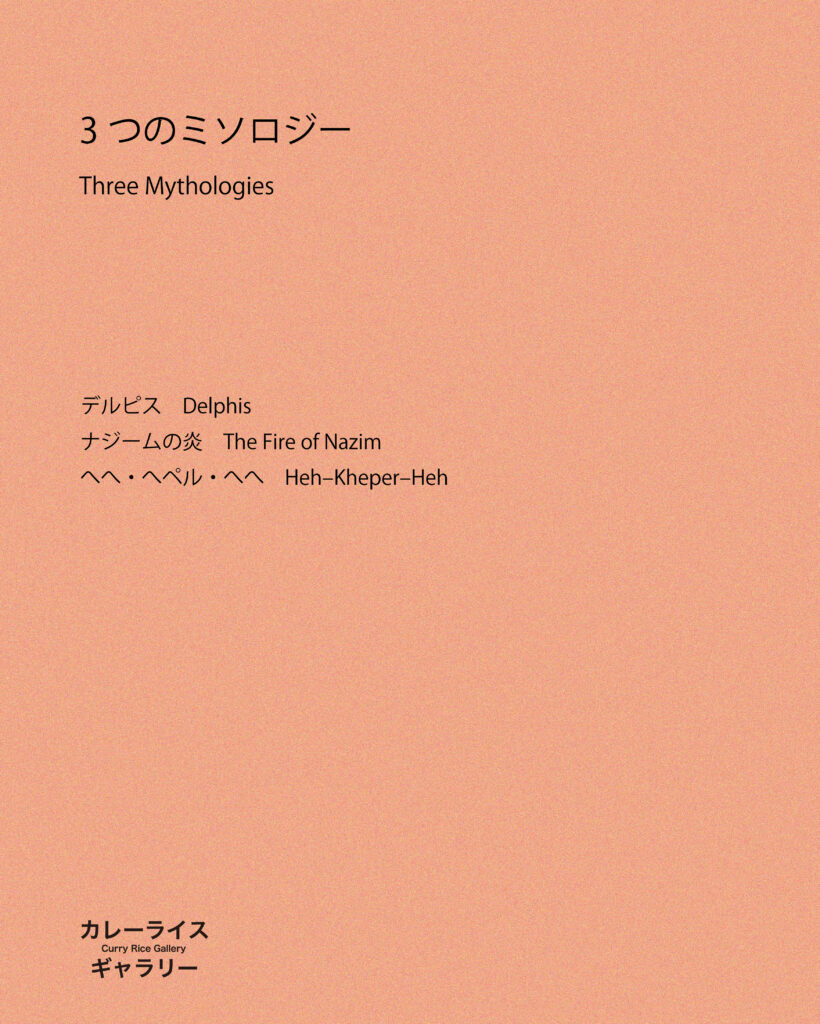
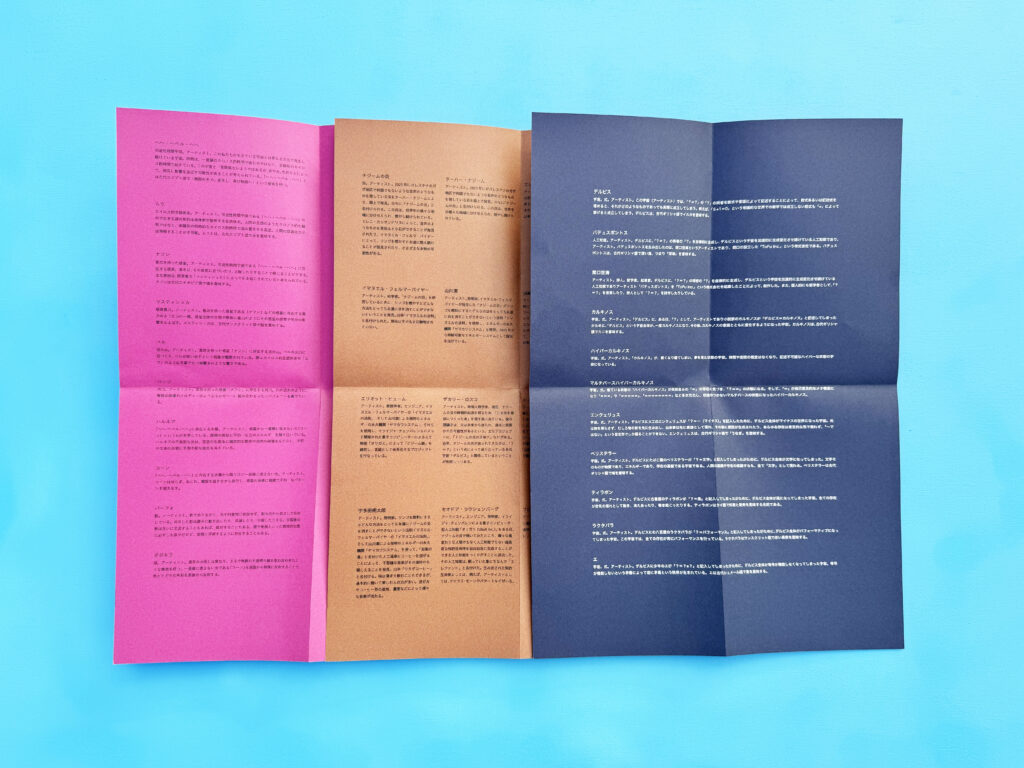

ミソロジカルアーティストとは、神話的なアーティストという意味であり、この現実世界に実際に存在するわけではないアーティストである。 アーティスト中村悠一郎は、自分の名前とは異なる名義、つまり別名義をつくり、そのアーティストとして作品をつくることで知られるアーティストである。 中村は、2023年から別名義での制作を本格的に開始し、当初は人間を仮定した別名義が全てであったが、2025年に入ってから、自宅のアトリエも人間ではないが、一つのアーティストとして別名義を与えてもいいのではないか、と名義を考案する。そこからさらに進んで、実験的な制度を自ら考案し、その制度自体がアーティストとして展示したり、世界の事物や概念を名づけ直すかのように作家名を与えていく。 その後、世界の事物や概念だけではなく、架空の宇宙など現実の世界に存在しないフィクションの世界線での事物や概念に作家名を与えてアーティストにすることを思いつく。 それがここでいうミソロジカルアーティストである。 ミソロジカルアーティストは、イラストなどにしてもいいとは思うが、いまいち作品のつくり方がわからず、あえて作家名とプロフィールのみによって、断片的な情報から想像を膨らませていただくということがベストなのではないか、と考えた。 ここでは、2025年に考案した3つの異なる神話体系のプロフィールを紹介したいと思う。
ー
「3つのミソロジー」
会場:配布場所各所(100部限定)
展示作家:デルピス、ナジームの炎、へへ・へペル・へへほか
ー
レビュー『神話は現実の筋書きのうちに自分の場所を得る ――「3つのミソロジー」によせて』平岡希望
「缶切りで蓋を開けて内容物を取り出す。中をキレイに洗って乾かす。外側の蟹のレッテルを剥がし、その裏に接着剤を塗り直して、缶の内側に貼る。それから蓋を閉めて、ハンダ付けで密封する。その瞬間に、この私たちの宇宙はその缶の内側として、包み込まれる。この宇宙は密封されて、その外側に蟹のレッテルを貼られたわけだ。この宇宙の果てはどうなっているのか、この宇宙は開いているのか閉じているのか、その未解決の謎もそのまま謎として含んで、この宇宙は蟹の缶詰となったのである。〔……〕ところでこの宇宙の缶詰は蟹缶一つだけでなく、 鮭缶でも作り、トウモロコシ缶でも作ったわけで、 その点が重要である。つまり蟹缶は宇宙のほとんどを梱包しながら、そこにわずかな包み残しができた。しかしそれはもう一つの鮭缶によって宇宙もろとも包まれている。そしてその鮭缶にも宇宙の包み残しはあるのだけど、それはすでに蟹缶によって包まれているのだ。つまりAはBを包みながら、Bから包まれてもいる。同様にしてCDEがあるのであって、この宇宙はわずかな包み残しを別の缶が補いながら、いまは多重に包み込まれているわけである。そうやって宇宙の梱包は複合的に成立したのだ。」[1]
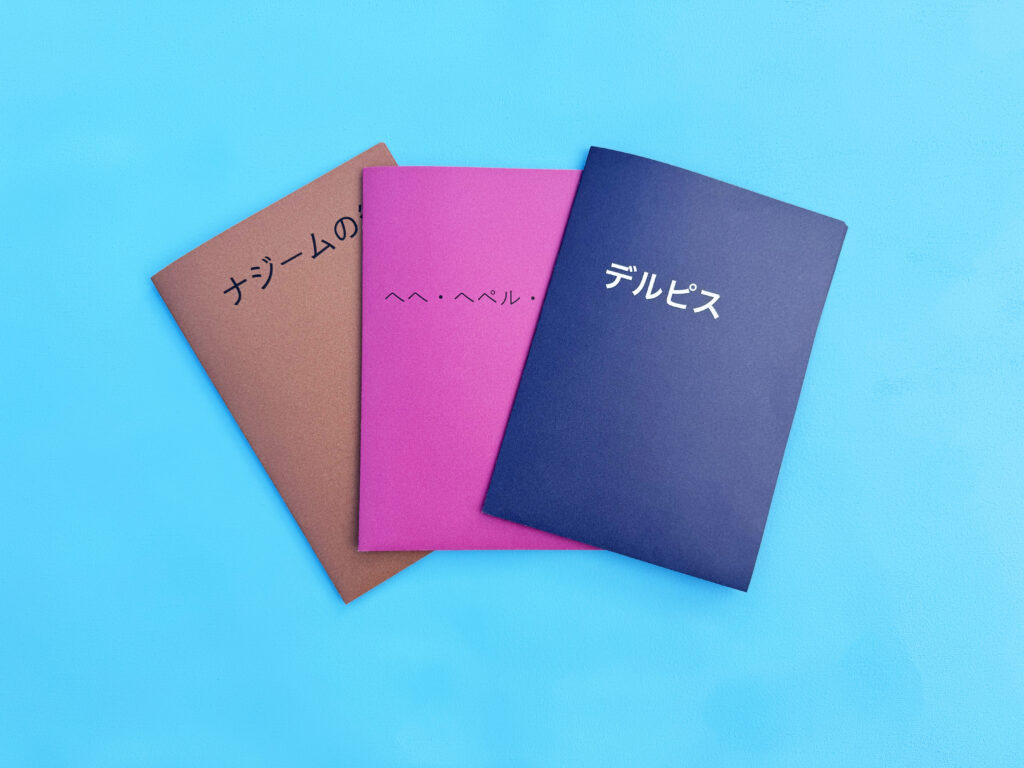
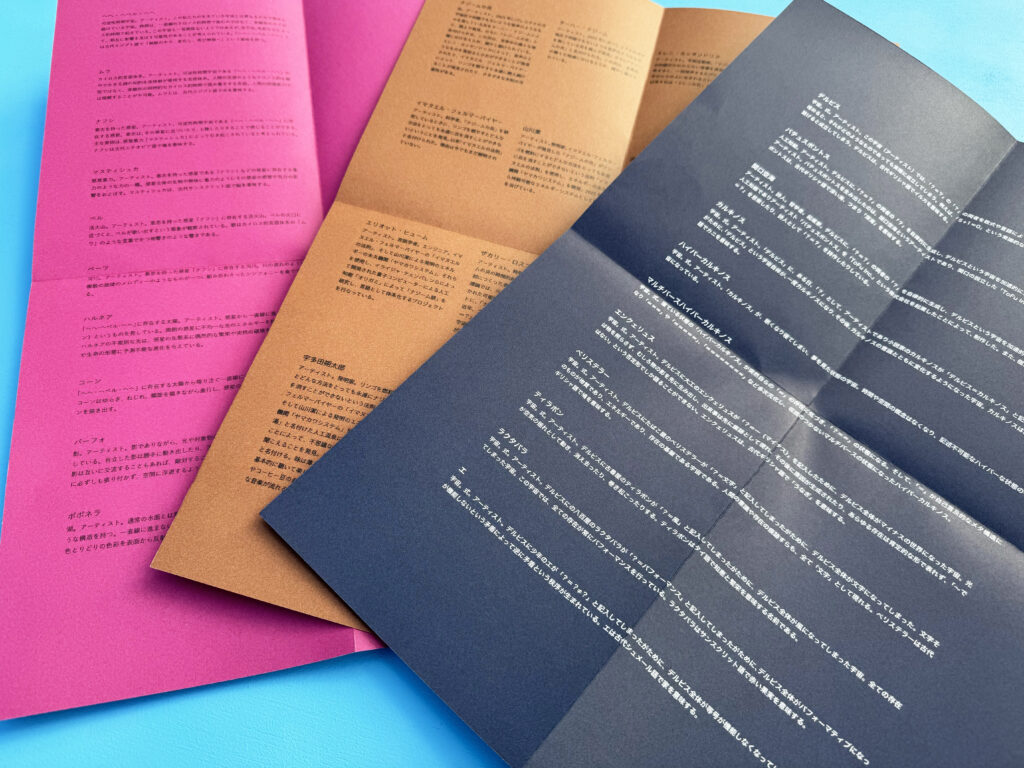
『デルピス』、『ナジームの炎』、『ヘヘ・ヘペル・ヘヘ』。これら3枚のリーフレットを開いていく動作自体が、蟹缶、鮭缶、トウモロコシ缶を順々に裏返して、宇宙を幾重も包み直していく行為みたいだ。濃紺の、A3四つ折りの紙上に並んだ11名のアーティストはすべて、1人目として記載された〈宇宙。式。アーティスト。この宇宙(アーティスト)では、「?=?」の「?」の両者を数式や言語によって記述することによって、数式あるいは記述式を埋めると、それがどのようなものであっても実際に成立してしまう。例えば、「5+1=0」という常識的な世界での数学では成立しない数式も「=」によって繋げると成立してしまう〉【デルピス】[2]に関与している。〈?=?〉に何かを代入することで。
〈アーティスト。詩人。哲学者。起業家〉の【関口空海】は、等式の両辺に縁もゆかりもない言葉を代入し、《ふわふわメロンパン=アメリカ合衆国》や《優しさ=遺跡》といった作品を生成した[3]。〈大工のエンクェリュス〉は、等式の右辺にマイナスを代入することで〈?=-(マイナス)〉が成立する〈宇宙。式。アーティスト〉の【エンクェリュス】[4]を、〈たばこ屋のペリステラー〉は〈?=文字〉の〈宇宙。式。アーティスト〉である【ペリステラー】[5]を生み出した。同様に、〈風〉と〈パフォーマンス〉がそれぞれ右辺に代入されて生まれたのは【ティラポン】[6]と【ラクタパラ】[7]だ。そして〈アーティストであり小説家のカルキノス〉も【カルキノス】を生み出した。自身を代入し、等式〈デルピス=カルキノス〉を成立させることによって。〈「デルピス」という宇宙自体が、一度カルキノスになり、その後、カルキノスの意識とともに変化するようになった宇宙〉は、〈眠くなり寝てしまい、夢を見た〉ことで〈時間や空間の概念〉を喪失した。そうして【ハイパーカルキノス】となった彼(?)が、〈突然自らの「=」の存在に気づき、「?==」の状態になる。そして、「=」が自己言及的なメタ構造になり「===」や「=====」、「========」など多次元化〉することで至った【マルチバースハイパーカルキノス】は、
「古い盟約の執行者、
無限とも見えるそれらが
定めどおりに不眠不休、生殖の
行為さながら世界を増殖させていく。」[8]
ボルヘスを戦慄せしめた鏡のように私たちへと迫る。〈古代シュメール語で家を意味する〉名を与えられた〈少年のエが「?=?≠?」と記入してしまったがために、デルピス全体が等号が機能しなくなってしまった宇宙〉は【エ】と呼ばれ、「つまりAはBを包みながら、Bから包まれてもいる。同様にしてCDEがあるのであって、この宇宙はわずかな包み残しを別の缶が補いながら、いまは多重に包み込まれているわけである。そうやって宇宙の梱包は複合的に成立したのだ」と赤瀬川原平が自作を評した言葉のように、“デルピス神話” では複数の宇宙=等式が併存しており、その宇宙はまた別の神話にも繋がっていく。すなわち、『ナジームの炎』へと。
〈アーティスト。時間人類学者。現在、【ナジームの炎】の時間的起源を探るため、「この炎を最初につくった者」を探す旅に出ている。彼の理論では、火は未来から送られ、過去に置かれた可能性があるという。主なプロジェクトに、「【ナジームの炎】の正体?」などがある。近年、【ナジームの炎】が送られてきたのは、「?=?」という式によって成り立っている多元宇宙【デルピス】と関係しているということが判明しつつある。〉
二つの神話を繋ぐのは【ザカリー・ロスコ】だ。彼が研究しているのは、アーティストの【タ―ハー・ナジーム】が〈2025年にパレスチナのガザ地区で〉発見した、〈何語でもないような音声のようなものを発している炎〉でありアーティストの【ナジームの炎】で、さらに〈アーティスト。平和活動家〉である【エレニ・カッサンドリヌ】は、その〈何語だかわからない言葉を真似て自分で発声〉すると、〈一回発声するたびに小さな小石が手のひらの上に生まれるということ〉を見出した。
「『子を産むという石だ、こいつは!』と彼は叫んだ。『今でも大へんな数だが、まだまだ増えるぞ。形は満ちているときの月の形で、色は夢でしか見ることのできないあの青い色を帯びるんだ。わしの親のそのまた親が小石の力の話をしていたが、あれは嘘ではなかった。』」[9]
〈「エレニの石」と名付けられた〉それは、同じく〈アーティスト。平和活動家〉の【カノックワン・ラッタナポン】によって世界中で収集され(ということは、エレニの石は特殊能力というより現象なのだろう)、〈「カノックワンの山」というプロジェクト〉に用いられた。同プロジェクトは、【ナジームの炎】が燃えていた場所に、その代わりとして「エレニの石」を山積みにするというものだった。
カノックワンの山は、いわば遅れてやってきた影のように【ナジームの炎】の名残りを留めるが、〈【ナジームの炎】の周囲にだけ生える特殊な藻類〉「スフルリス」はそのときにはもう絶えているだろう。発見者である〈アーティスト。植物学者〉の【ティナ・セレク=ユリオス】によれば、〈その藻類の胞子には、ナジーム語の音声波形に似た形状が存在〉しており、〈アーティスト。言語学者。エンジニア〉である【エリオット・ヒューム】も〈「ナジーム語」を研究し、言語として体系化するプロジェクトを行なっている〉。用いる道具は二つ。まずは〈アーティスト。科学者。エンジニア〉であり〈株式会社「Ubull Inc.」の代表〉でもある【イライジャ・チェンバレン】によって開発された〈量子コンピューター型人工知能「オリガミ」〉。もう一つは、〈アーティスト。発明家〉の【山川潔】によって開発された〈2025年から持続可能なエネルギーシステムとして脚光を浴びている〉〈永久機関「ヤマカワシステム」〉であり、同システムを支えるのは「イマヌエルの法則」だ。その名のとおり、〈アーティスト。科学者〉の【イマヌエル・フェルマーバイヤー】によって発見されたこの法則は、【ナジームの炎】でリンゴを燃やすとどんな方法でも永遠に消えなくなるというもので、【ナジームの炎】自体も、物体を変化させる力を持っている。たとえば〈量子コンピューター型人工知能「オリガミ」〉は、〈アーティスト。エンジニア。発明家〉の【セオドア・ラウシェンバーグ】の手で【ナジームの炎】に投じられ人工知能「エレファント」となった。エレファントは、〈様々な風変わりな人間でもなく人工知能でもない超高度な知的生命体を自由自在に生成することができる人工知能〉であり、「竹林の竹の一部を切るとその筒状の空間の中から別の宇宙へ行くことができたりする」「さまざまな不思議な創作竹林を制作」する「竹林アーティスト」の【サイラス・モーン】[10]は「『エレファント』によって人工的につくりだされた超高度な知的生命体」だが、彼(?)の逸話は、『ナジームの炎』の茶色のリーフレットに書かれてはいない。どうやら “ナジーム(の炎)神話” の範疇を超えてしまっているようだ。
本展は『3つのミソロジー』と題されているが、小さな神話体系あるいはその萌芽を含めれば、3つでは済まない。たとえば “エフィゲニア(隕石)神話”。「アーティスト。探検家。科学者」の【エフィゲニア・カランデュリ】[11]によって発見された、「手のひらサイズ」で「わずかに振動している」「謎の隕石」たる「エフィゲニア隕石」は、「石に音を聴かせて、数回振ると未来にその音を送信することができ、石を回転させることによって再生することができる」。そして、「石を振れば振るほどより先の未来に音を送信することができる」その不思議な性質は、人工知能「オリガミ」によって研究が進められており、音と石という組み合わせからエレニの石が連想されるように、「世界各地の神話の中でも『未来を歌う石』のような伝承が存在していたこと」を、「エフィゲニア隕石は一つではない」ことを発見したのは「アーティスト。研究者」の【レティシア・オリヴェイラ】[12]だった。
その後、「エフィゲニア隕石」が「サウンドアーティスト」の【マルジャーナ・クワシメ】[13]や、「世界中のアーティスト、科学者、シャーマンなどが、エフィゲニア隕石を奏でたり、聴いたりするために国境を超えて集まり結成」した【未来の音の共同体】[14]に利用されていく展開もナジーム神話と重なる。というのは、イマヌエルの法則とヤマカワシステムを用いて〈アーティスト。発明家。実業家〉の【浜崎克衛】が人工温泉「克衛の湯」を開発したからであり、さらにその克衛の湯に〈アーティスト。発明家〉の【宇多田朔太郎】はコーヒーを混ぜた。「ウタダコーヒー」と名付けられたのは、〈混ぜ方やコーヒー豆の産地、濃度などによって様々な〉〈不思議な音楽がその液体から聞こえる〉という現象で、先に登場したオリガミの開発者【イライジャ・チェンバレン】は、(おそらくオリガミとは別の)〈研究中の人工知能を【ナジームの炎】で焚かれている「克衛の湯」に沈めたところ、奇跡的に未来の写真を撮影することができる画像生成AIの発明に成功。「キョウト」と名付け〉た。そして、アーティストの【イェナカ・スブラマニヤム】が、〈未来写真AI「キョウト」の画像を解析し、様々な風景絵画を描いている〉ように、〈アーティスト。実験家〉の【フローレンス・アプリン】によって、〈【ナジームの炎】の近くに磁石を近づけると磁石が水のような透明な液体に変化すること〉として発見された「フローレンスの水」は、すぐさま、アーティストの【イモージェン・ペンハリゴン】によって光を当てられた。比喩ではない。暗闇でフローレンスの水に光を通すと〈抽象から具象、文字に至るまで様々なストーリーのない映像が投影されることが判明〉し、〈のちに「イモージェンの光」と呼ばれる〉その現象は、【マリカ・ナスリーン】によって研究が進められ、「フローレンスの水を媒介として、液体に小さな振動を与えると、距離の離れたフローレンスの水同士が同じ周波数で振動すること」が見出された。その原理を応用して開発されたのは、振動によって「人間の感情そのものを伝えられる」「新しい通信装置」「マリカ・ハイドロフォン」だが、【マリカ・ナスリーン】もまた、ナジーム神話に含まれてはいない。それはむしろ “フローレンス(の水)神話”の始まりかもしれない。
【ザカリー・ロスコ】という〈アーティスト。時間人類学者〉によって結びつけられたデルピス神話とナジーム神話。後者はさらに、【サイラス・モーン】をはじめとする超高度人工知的生命体たちの、エフィゲニア隕石の、フローレンスの水の神話へと枝分かれしていったが、残された最後のリーフレットに記された “ヘヘ・ヘペル・神話” は、それらに比べると一見閉鎖的だ。
〈可逆性時間宇宙。アーティスト。この私たちの生きている宇宙とは異なる次元で発生し続けている宇宙。時間は、一直線のクロノス的時間で進むのではなく、非線形のカイロス的時間で起きている。この宇宙と一見関係ないようではあるが、音や光、色彩などによって、相互に影響を及ぼす可能性があることが考えられている。「へへ・へペル・へへ」とは古代エジプト語で「無限の中で、変化し、再び無限へ」という意味を持つ。〉
と定義された〈【へへ・へペル・へへ】の中で生きる謎の知的生命体群が使用する言語体系〉自体もまた【ムウ】というアーティストであり、その宇宙に浮かぶ太陽もまた【ハルネア】と呼ばれるアーティストだ。彼(?)が発する〈一直線に進まない光。アーティスト〉の【コーン】が、〈ゆらぎ、ねじれ、螺旋を描きながら進行し、惑星の地表に複雑で不均一なパターンを描き出す〉その惑星の一つがおそらく〈意志を持った惑星。アーティスト〉の【ナフシ】であり、その意志の源泉は〈惑星全体の生物や物体に重力のようにその惑星の感覚や気分の影響をおよぼす〉〈感覚重力。アーティスト〉の【マスティシュカ】らしい。だからか、惑星【ナフシ】に存在する活火山は歌い[15]、河川は奏する[16]。〈湖。アーティスト〉の【ポポネラ】が、〈通常の水面とは異なり、まるで無数の半透明の鏡を重ね合わせたような〉〈色とりどりの色彩を表面から反射〉しているのは〈一直線に進まない光〉【コーン】の仕業であり、私たちの世界では光に随伴するはずの影が、この宇宙ではアーティストとなって跳梁する。【パーフォ】と名づけられたそれは、
〈影でありながら、光や対象物に依存せず、影の元から自立して存在している。自立した影は勝手に動き出したり、消滅したり、分裂したりする。分裂後の影は互いに交流することもあれば、敵対することもある。壁や地面といった物理的な面に必ずしも張り付かず、空間に浮遊するように存在することもある。〉
「私はすばやく手綱を引くと馬首を変え、ヤッとばかりに拍車をくれて脇道に走りこみました。ところが影は同行してくれないのです。こちらの行方には馬耳東風で道に立ちどまり、持主がもどってくるのを待ち受けているのです。私はしおしおと馬を返すしかありませんでした。灰色のマントの男は何ごともなかったように悠々と口笛を吹き終わるとせせら笑いを洩らしてから、またもとどおりに影を取りつけました。ついては私がふたたび合法的な持主にならない限り、どうにもならないと念を押すのでした。」[17]
210年ほど前に書かれた『影をなくした男』でも、姿を見せてはいなかったか。
「文学においても唯一の主体の観念は万能である。書物に署名があることは珍しい。剽窃の観念は存在しない。あらゆる作品はただ一人の著者の作品であり、彼は無時間的かつ無名のものであると規定されている。批評がよく作者をでっち上げる。(たとえば 『道徳経』とか『千夜一夜物語』のような)ふたつのことなる作品を取りあげて、それらをおなじ一人の作家のものであるとした上で、この興味ぶかい文人(オム・ド・レトル)の心理を誠実に推理する……。」[18]
「一八八四年、コンコードの町でもう一人の精神の筆耕が次のように書きとめた。『地上にあるすべての本を一人の人間が書いたというふうに考えることも可能である。すべての書物を通じて中心となる一貫性が見られるが、それを考えれば書物がたったひとりの全知の紳士が書いたものだということは否定できないはずである。」(エマソン『エッセイ』二、Ⅷ)。その二十年前には、シェリーが過去、現在、未来のすべての詩は地上のすべての詩人によって書かれた無限の詩のエピソード、もしくは断片であると書いている(『時の擁護』、一八二一)」[19]
ボルヘスは自作やエッセイで、作家の複数性を揺るがすような思想を語った(むしろ、この考えに従えば「代弁した」と言った方が正しいだろう)が、
「この野球年鑑に、ヘンリーは選手成績から始まり記者の特電に至るまで、また、ひとシーズン通しての分析から一般的な野球理論に至るまでUBAのすべてを書き込んだのだった。要するに、どんなことでも保存しておく価値があるということなのだ。文体も変化に富んでいた。余計な言葉を省いて実際的なデータのみを扱う極端に簡潔な文章があるかと思えば、スポーツ記者特有の誇張した言葉遣いがあった。また、理論家たちの科学的で客観的な文体があるかと思えば、随筆家や逸話作家たちの文学的な文体もあった。それに加えてテープに録音したインタビューや選手たちの寄稿記事、選挙関係の記事、死亡記事、諷刺、予想、醜聞なども混じっていた。年鑑では試合の細かな経過に触れなかった――たとえば、スター選手や主戦投手を喩えとして持ちだしたり、あるいは意図的に若干の思い違いを犯したりする場合を除いて、球団の分析にあたってはあえて選手個人に言及しなかった。それによって協会全体の概観的な視野が得られた。」[20]
野球ゲーム『ユニヴァーサル野球協会(UBA)』の創造主・ヘンリーが示した作家像は、超越者というよりは奉仕者としてのそれであり、結局、彼はサイコロの出目一つで狂わされた。作家とは、個を超えたところの 「無時間的かつ無名の、唯一の作家」[21]と、被造物にもかかわらず自律的でアンコントローラブルな作品との間で窮する存在なのかもしれない。ここで《宇宙の缶詰》に立ち戻れば、
「この缶詰をモデルとして、人間もまた梱包体であることを思い知るのだ。人間は中に内宇宙を包み込んだ缶詰的な存在である。人間が外宇宙を知覚するのは、その人が内宇宙の梱包体であることによる。その内宇宙を包む作業の持続が人間の存在であり、その持続を人生という。私たちはいずれ内宇宙を包む作業の持続を解くことによって、この宇宙の一点に釘付けされた釘を抜かれて、この関係を抜け出していく。〔……〕私たちの共同の外宇宙に対応して、共同の内宇宙というものがどのように存在するのか。それが蟹缶と鮭缶の複合的なパースペクティヴに包み隠されてあるのではないか。いずれ私たちの誰かがその隠されたキーに接近し、私たちの内宇宙はさらに果てしなき無限小に向かってひろがるだろう。」[22]
「宇宙の缶詰の比喩で言えば、もともと裏返されていたものを逆に表返して、他の缶詰と同じ状態に並べてしまうと、裏返されていたときには、世界の中の物を指す、客観的(objective)指示だったはずのことの一部が、 自分という個物の内側に向かう反省的・再帰的な指示に変わってしまうからです。すると、『すべての表象に自己意識が伴わねばならない』ことになります。かつては宇宙だったものが一個の缶の中に入って、その缶の中身になってしまうのです。そのことによって、いわゆる意識の私秘性が成立し、しかし同時にまさにそのことによって、 他の缶との客観的コミュニケーションが可能になるのです。私が『私は悲しい』と言えば、私=宇宙が悲しいのではもはやなく、口からその言葉を発している一人の人間が悲しいという心理状態にあるという意味になるので。」[23]
〈「デルピス」という宇宙自体が、一度カルキノスになり、その後、カルキノスの意識とともに変化するようになった宇宙〉である【カルキノス】とは、まさに「もともと裏返されていたものを逆に表返」すことで「私=宇宙」を経由し、「私たちの内宇宙」へ、「他の缶との客観的コミュニケーション」へと開かれていく過程を神話的[24]に描いたもののように思われる。そして、ここまで見てきてわかるように、『3つのミソロジー』を、というよりCream Soda Museum を形づくっている別名義たちは例外なくアーティストを名乗っているが、それは、
「一人の人間が作中で『小説家』としての役割を演じてみせることによって、あらためて表現行為自体を表現するというフィクションを生き直してみるということ。さらに、 それを言葉によって実践してみたとき、『私」内部にさまざまなブレが生じ始め、『私』が一個の実体から、持続する現象へと変貌してゆく瞬間が立ち現れるということ。こうした過程に着目してみることによって、従来ともすれば作家の『個性』や『人格』の等価物とみなされがちであった『私小説』に、あらたな再評価の視点が提起できるのではないか〔……〕むしろ徹底して『私』内部の差異にこだわる中で、ついに『私』でありながら『私』たりえぬ〝何か〟 が触知されてゆくパラドックスにこそ、近代独自のリアリズムの形成されてゆく契機が秘められていたのではないか」[25]
「『私』が小説家たりうるかどうかを検証してゆく行為そのものが言説の枠組を決定してゆく」[26]私小説のようだ。中村さんは、別名義アーティストの創造という方法論を通じて「徹底して『私』内部の差異にこだわる中で、ついに『私』でありながら『私』たりえぬ〝何か〟 が触知されていくパラドックス」へ至ろうとしているのかもしれない。そのとき、
「そこでは従来説かれて来たように芸術と実生活の一致がめざされていたというよりも、むしろ決して一致しえぬそのズレを通して、『私』の見え方(遠近法)そのものが問われてきたと考えるべきなのであって、その多くが『小説の書けない小説家』の形をとるのも、『見え方』のヴァリエイションは不断の否定形を通して初めてその描出が可能になるという創造の機微にかかわるものであったにちがいない。」[27]
たとえば今回のような「架空の宇宙など現実の世界に存在しないフィクションの世界線での事物や概念に作家名を与え」た「ミソロジカルアーティスト」[28]や、それ以前の「アーティスト。アーティストではあるが、作品を実物ではなく、頭の中だけで妄想することによって仮想的に作品を制作する」【ケイデン・コタード】[29]、「ノットアーティスト。自らをアーティストとは名乗らず、「ノットアーティスト(Not Artist)」という肩書のもとで活動している」【カーソン・グッドオール】[30]といった「小説の書けない小説家」ならぬ “作品の作れない作家” が、その “作らなさ” や “作れなさ” の程度やスタンスに違いはあれどCream Soda Museum に一定数存在していることこそ、「不断の否定形を通して初めてその描出が可能になる」「『見え方』のヴァリエイション」を担保しているのだろうし、そこから、
「『環状交換』ともいうべき興味深い贈与交換の体系である〈クラ〉では、〈ムワリ〉mwaliと呼ばれる白い貝の腕輪と〈ソウラヴァ〉soulavaと呼ばれる赤色の貝のネックレスとが、お互いに反対回りで大きな円環を描くように、島伝いの人々の手を介して贈り物として回っていた。〔……〕航海術に長けたメラネシア海民たちによって美しい装飾を施されたカヌーで財物が島々を渡り、それがつぎつぎと隣の島の交換のパートナーに手渡されて輪の中を動くうちに、種類の違ういろいろな品物と出逢い、新たな物語を生み出してゆく。すなわちここで贈与・交換されているのは、たんにモノとしての財物だけでなく、それにまつわるさまざまな伝承や新たに付与された物語も含んだ、群島人たちの神話と生活世界の統合的ヴィジョンそのものなのである。クラはその意味で、私たちの近代世界の等価交換にもとづく市場経済の原理とは根本的に異なった、一種の贈与経済の宇宙を指向していると考えられる。」[31]
「神話と生活世界の統合的ヴィジョン」ともいうべき視座が復活し、ふたたび贈与されるのかもしれない。「創造する英雄」 [32]たる八百万のアーティストたちから、私たちへと。
〈了、あるいは『宇宙の缶詰、缶詰の宇宙 ――「限界缶詰ゲーム」によせて』へ続く〉
注
タイトルは、マフムード・ダルウィーシュ/著,四方田犬彦/訳「壁に描く」(『パレスチナ詩集』ちくま文庫,p.124)による。
なお、引用したURLの最終閲覧日は、すべて2026年4月7日である。
[1]赤瀬川原平『芸術原論』岩波現代文庫,pp.156-158
なお、アーティストの奥村雄樹氏は『多元宇宙の缶詰』と題したWSを実施し、かつ同名の(映像インスタレーション)作品を制作しているようだ。詳細については以下を参照のこと。
https://www.yukiokumura.com/works/multiverse.html (ポートフォリオサイト)
https://blanclass.com/ja/events/20121117/ (WSアーカイブページ)
https://vimeo.com/133515739 (映像作品《Canned Multiverse | 多元宇宙の缶詰》)
https://artscape.jp/report/curator/10094072_1634.html (展覧会レビュー)
[2]『3つのミソロジー』リーフレットより。以降、〈〉内についてはすべて同リーフレットからの引用とし、中村さんによって考案されたアーティストについては本文・注釈・引用部にかかわらず全て【】を付す。
なお、各アーティストのプロフィールについては、中村さんによって考案された250以上を超える別名義のほとんどが収蔵されたオンラインミュージアム「Cream Soda Museum」にて確認できる(https://creamsodamuseum.org/ )。
[3]【フリオ・アンドレス・モンタルボ】主宰の「Octopus Gallery」(オンライン)にて開催中の個展『デルピス』より(https://creamsodamuseum.org/%e3%83%87%e3%83%ab%e3%83%94%e3%82%b9%e3%80%80%e9%96%a2%e5%8f%a3%e7%a9%ba%e6%b5%b7/ )。
なお、【関口空海】は〈アーティストの【デルピス】に、「?=?」の両者の「?」を自律的に生成し、【デルピス】という宇宙を加速的に生成変化させ続けている人工知能でありアーティスト【バテュスポントス】を「ToFu Inc.」という株式会社を起業したことによって、制作した〉ともされている。
[4]〈光は物を照らさず、むしろ物の影を先に生み出し、出来事は先に痕跡として現れ、その後に原因が生成されたり、あらゆる存在は肯定的な形で表れず、「〜ではない」という否定形でしか語ることができない。〉と詩的に形容された〈デルピス全体がマイナスの世界になった宇宙〉のこと。
[5]〈人間の意識や存在の痕跡すらも、全て「文字」として現れる〉〈文字そのものが物質であり、エネルギーであり、存在の基盤である宇宙〉のこと。
[6]〈古着屋のティラポン〉によって生み出された、〈全ての存在が空気の揺れとして動き、消え去ったり、巻き起こったりする〉〈デルピス全体が風になってしまった宇宙〉のこと。
[7]〈八百屋のラクタパラ〉によって生み出された、〈全ての存在が常にパフォーマンスを行っている宇宙〉のこと。
[8]ホルヘ・ルイス・ボルヘス/著,鼓直/訳「鏡」『創造者』岩波文庫,p.108
[9]ホルヘ・ルイス・ボルヘス/著,内田兆史,鼓直/訳「青い虎」『シェイクスピアの記憶』岩波文庫, p.42
[10]https://creamsodamuseum.org/artist-3/ の【サイラス・モーン】プロフィールより。
[11]【エフィゲニア・カランデュリ】のページより。https://creamsodamuseum.org/%e3%82%a8%e3%83%95%e3%82%a3%e3%82%b2%e3%83%8b%e3%82%a2%e3%83%bb%e3%82%ab%e3%83%a9%e3%83%b3%e3%83%87%e3%83%a5%e3%83%aa/
[12]https://creamsodamuseum.org/artist-4/ の【レティシア・オリヴェイラ】プロフィールより。
[13]https://creamsodamuseum.org/artist-3/ の【マルジャーナ・クワシメ】プロフィールより。
[14]https://creamsodamuseum.org/artist-4/ の【未来の音の共同体】プロフィールより。
[15]〈カイロス的言語体系の【ムウ】のような言葉でかつ地響きのような響きで〉歌う〈活火山。アーティスト〉の【ペル】のこと。
[16]〈複数の旋律のメロディーのようなものが一つに組み合わさったシンフォニーを奏でている〉〈河川。アーティスト〉の【ベーツ】のこと。
[17]アーデルベルト・フォン・シャミッソー/著,池内紀/訳『影をなくした男』岩波文庫,p.95
[18]ホルヘ・ルイス・ボルヘス/著,鼓直/訳「トレーン,ウクバール,オルビス・テルティウス」『伝奇集』岩波文庫,p.30
[19]ホルヘ・ルイス・ボルヘス/著,木村榮一/編訳「コールリッジの花」『ボルヘス・エッセイ集』平凡社ライブラリー,pp122-123
[20]ロバート・クーヴァー/著,越川芳明/訳『ユニヴァーサル野球協会』白水Uブックス,pp.83-84
[21]堀内研二「『夢の本』について」ホルヘ・ルイス・ボルヘス/著,堀内研二/訳『夢の本』河出文庫,p.335
[22]『芸術原論』pp.157-158
[23]永井均『改訂版 なぜ意識は実在しないのか』岩波現代文庫,p.145
[24]cf.,「中村雄二郎は、『科学の知は、その方向を歩めば歩むほど対象もそれ自身も細分化していって、対象と私たちとを有機的に結びつけるイメージ的な全体性が対象から失われ、したがって、対象への働きかけもいきおい部分的なものにならざるをえない」と述べ、 科学の知の特性を明らかにし、それに対して、『神話の知の基礎にあるのは、私たちをとりまく物事とそれから構成されている世界とを宇宙論的に濃密な意味をもったものとしてとらえたいという根源的な欲求』であると指摘している。」(河合隼雄/著,河合俊雄/編『〈物語と日本人の心〉コレクション Ⅲ 神話と日本人の心』岩波現代文庫,pp.8-9)
[25]安藤宏『定本 自意識の昭和文学 現象としての「私」』岩波現代文庫,pp.275-276
[26]同書,p.33
[27]同書,pp.33-34
[28]『3つのミソロジー』ステートメントより。
[29]【ケイデン・コタード】のページより。https://creamsodamuseum.org/%e3%82%b1%e3%82%a4%e3%83%87%e3%83%b3%e3%82%b3%e3%82%bf%e3%83%bc%e3%83%89/
[30]【カーソン・グッドオール】のページより。https://creamsodamuseum.org/%e3%82%ab%e3%83%bc%e3%82%bd%e3%83%b3%e3%83%bb%e3%82%b0%e3%83%83%e3%83%89%e3%82%aa%e3%83%bc%e3%83%ab/
[31]今福龍太『群島-世界論 パルティータⅡ』水声社,pp.308-309
[32]「現代の英雄、つまり自分が呼び寄せられたことを気にかけ、人類が運命をともにする存在の住まう場所を探し求める個人は、自分が属する共同体が、うぬぼれや恐怖、合理化された欲望、聖化された勘違いといった古い衣服を脱ぐことを期待できない。ニーチェは次のように語っている。『生きよ、あたかもその日が来たかのように』創造する英雄を社会が導き救うのではなく、反対に、創造する英雄が社会を導き救うのである。こうして、私たち一人ひとりが究極の試練にのぞむ(救世主の十字架を担ぐ)。しかも、社会全体が大勝利をおさめる輝かしい瞬間にではなく、個人的絶望のうちに黙々と試練にのぞむのである。」(ジョーゼフ・キャンベル/著,倉田真木,斎藤静代,関根光宏/訳『千の顔をもつ英雄〔新訳版〕下』ハヤカワ文庫NF,p.291)
ー
平岡希望 Nozomu Hiraoka
1990年、東京生まれ。2013年、学習院大学文学部心理学科卒業。同時代の美術作家・作品に感化され、2022年頃より、展示空間で過ごした時間や作品から喚起されたイメージなどを書き残しはじめる。2024年4月には、佐塚真啓(美術家、国立奥多摩美術館館長)、下山健太郎(画家、ハンマー出版主宰)、三熊將嗣(フレミスト)三氏の企画、およびアーティスト・アート関係者およそ70名の協力によりクラウドファンディングを実施。160名を超える支援を得て、同年5月より、ひと月分の展示や公演などを数珠つなぎにした日記/エッセイ/小説/批評風のzine『平岡手帖』を1年間毎月刊行。その他の掲載書籍としては、中島りか『私的なまま、現れる』、南壽イサム『花粉の季節』、阿目虎南・腰山大雅『Glowing Ember』(すべて2024年刊)などがある。ウェブ媒体としては、「Curry Rice Gallery」以外にも「最小現代アートギャラリー callbox」、「オルタナティブ掘っ立て小屋『ナミイタ Nami Ita』」、「アート55(ゴーゴー)― 町田で55人のアーティストを紹介するプロジェクト ―」、「演劇フリースペース・サブテレニアン」などに寄稿・連載中。最近では、テキストを寄せるかたちで展覧会に参加したりもしている。https://www.instagram.com/nozomuhiraoka/?hl=ja
ー
A mythological artist is a mythical artist, an artist who does not actually exist in the real world.
Artist Nakamura Yuichiro is known for creating aliases other than his own, and creating works under those aliases.
Nakamura began working in earnest under his aliases in 2023. Initially, all of his aliases were assumed to be human, but in 2025, he came up with the idea of giving his home studio, which is not human, another name as an artist, also as such. He went further from there and devised an experimental system, exhibiting works as artists and giving artist names to objects and concepts in the world as if renaming them.
He then came up with the idea of giving artist names not only to objects and concepts in the world, but also to objects and concepts from fictional worlds that do not exist in the real world, such as fictional universes, and turning them into artists.
This is the mythological artist referred to here.
While I think mythological artists could be used for illustrations, I wasn't quite sure how to create such works, so I thought it would be best to let the reader expand their imaginations based on fragmented information, such as the artist's name and profile.
Here, I would like to introduce the profiles of three different mythologies I came up with in 2025.
ー
"Three Mythologies"
Venue: Various distribution locations (limited to 100 copies)
Exhibiting Artists: Delpis, Naseem's Flame, Hehe Hepel Hehe, and others
ー
Review "Myths Find Their Place in Real-World Scripts: On 'Three Mythologies'" Nozomu Hiraoka
"You open the lid with a can opener and take out the contents. You wash the inside thoroughly and dry it. You peel off the crab label on the outside, reapply glue to the back, and stick it to the inside of the can. Then you close the lid and seal it with solder. At that moment, our universe is enclosed as the inside of that can. This universe is sealed, and a crab label is attached to the outside. This universe has become a canned crab, including the unsolved mysteries of what lies at the edge of this universe, and whether this universe is open or closed. […] By the way, this canned universe is not just a can of crab; we also made canned salmon and canned corn." That point is important. In other words, the crab can has wrapped almost the entire universe, leaving a small gap. However, this gap is then wrapped along with the universe by another salmon can. And that salmon can also has a gap in the universe, but that gap is already wrapped by the crab can. So A wraps B, and is also wrapped by B. Similarly, there are CDEs, and this universe is now wrapped in multiple layers, with other cans filling in the small gaps. That's how the universe's packaging was complexly established. [1]
'Delphis,' 'Nazim's Fire,' 'Hehe Heper Hehe.' The act of opening these three leaflets is like turning over the crab can, salmon can, and corn can one after another, re-wrapping the universe in multiple layers. The 11 artists listed on the dark blue, A3-fold paper are all the same as the first one listed: 'Universe. Formula. Artist.' In this universe (artist), by describing both sides of "?=?" using mathematical formulas or language, filling in the formula or descriptive expression makes it actually valid, no matter what it may be. For example, even a mathematical expression that doesn't work in the conventional world of mathematics, such as "5+1=0", becomes valid when connected by "=" [Delphis] [2]. This is related to substituting something into .
[Sekiguchi Kukai] substituted unrelated words into both sides of an equation, creating works such as "Fluffy Melon Bread = United States of America" and "Kindness = Ruins" [3]. created [Enquelus] [4] where is valid by substituting a minus sign into the right side of the equation, while created in the <Universe. Formula. This gave birth to the artist [Peristeller] [5]. Similarly, substituting "wind" and "performance" on the right-hand side resulted in [Tirapong] [6] and [Raktapara] [7]. And [Karkinos, the artist and novelist] also gave birth to [Karkinos] by substituting himself and making the equation [Delphis = Karkinos] valid. [The universe called "Delphis" itself once became Karkinos, and then the universe began to change along with Karkinos's consciousness] lost its [concepts of time and space] when it [got sleepy, fell asleep, and had a dream]. Thus, he (?), who had become [Hyper Karkinos], [suddenly became aware of the existence of his own "=" and entered the state of "?==". And the "=" becomes a self-referential metastructure, multidimensionalizing into "===", "= The universe in which the entire Delphis universe ceased to function as an equals sign because a boy named E, given the name meaning "house" in ancient Sumerian, wrote "?=?≠?", is called "E". As Genpei Akasegawa described his own work, "In other words, A encloses B, and is also enclosed by B. Similarly, there are CDE, and this universe is now multiple times enclosed, with other cans filling in the small remaining gaps. That is how the packaging of the universe was complexly established." In the "Delphis myth," multiple universes = equals coexist, and these universes connect to other myths, namely, to "The Flame of Nazim."
Artist. Time anthropologist. Currently on a journey to find "the one who first created this flame" in order to explore the temporal origin of "The Flame of Nazim." His theory suggests that fire may have been sent from the future and placed in the past. His main projects include "The True Identity of "The Flame of Nazim?". In recent years, it has become clear that the "Nazim's Flame" is connected to the multiverse "Delphis," which is governed by the equation "?=?".
Connecting these two myths is Zachary Rothko. He is researching the "flame emitting a sound-like voice that doesn't seem to belong to any language," discovered by artist Taha Nazim in the Gaza Strip in Palestine in 2025. Furthermore, artist and peace activist Eleni Cassandrinu discovered that when she imitated the unknown language, a small pebble appeared on her palm with each utterance.
"'This is a stone that gives birth!' he exclaimed. 'There are already a great many, but there will be even more. Its shape is like a full moon, and its color is that blue that can only be seen in dreams. My great-great-grandfather spoke of the power of pebbles, and he wasn't lying.'" [9]
These stones, named "Eleni's Stones," were collected worldwide by Kanokwan Rattanapong, also an artist and peace activist (suggesting Eleni's Stones are more of a phenomenon than a special ability), and used in the "Kanokwan's Mountain Project." This project involved piling up Eleni's Stones in place of the flames of Naseem.
The mountains of Kanokwan retain the remnants of the Flames of Nazim, like a belated shadow, but the special algae "Shururis," which grows only around the Flames of Nazim, will have died out by then. According to its discoverer, artist and botanist Tina Selek-Yurios, the algae's spores have shapes similar to the sound waveforms of the Nazim language, and artist, linguist, and engineer Elliot Hume is also researching the Nazim language and working on a project to systematize it as a language. There are two tools to use. First, there is the quantum computer-type artificial intelligence "Origami," developed by Elijah Chamberlain, who is also an artist, scientist, engineer, and CEO of Ubull Inc. The other is… Developed by inventor Kiyoshi Yamakawa, the perpetual motion machine "Yamakawa System" has been attracting attention as a sustainable energy system since 2025, and is supported by "Immanuel's Law." As the name suggests, this law, discovered by artist and scientist Immanuel Fermabayer, states that if you burn an apple in the Flame of Nazim, it will never go out no matter what method you use, and the Flame of Nazim itself has the power to change objects. For example, the quantum computer-type artificial intelligence "Origami" was thrown into the Flame of Nazim by artist, engineer, and inventor Theodore Rauschenberg and became the artificial intelligence "Elephant." Elephant is an artificial intelligence capable of freely generating various eccentric, highly intelligent life forms that are neither human nor artificial intelligence. Cyrus Morn [10], a "bamboo forest artist" who "creates various fantastical bamboo forests" and "allows users to travel to other universes through the tubular space created by cutting a section of bamboo in a bamboo grove," is a "highly intelligent life form artificially created by Elephant," but his (?) anecdotes are not included in the brown leaflet for "The Fires of Nazim." It seems to have gone beyond the scope of the "Nazim (fire) myth."
This exhibition is titled "Three Mythologies," but if we include small mythological systems or their nascent stages, it's more than three. For example, the "Ephigenia (meteorite) myth." Discovered by artist, explorer, and scientist Ephigenia Calanduri [11], the "Ephigenia meteorite," a "palm-sized," "slightly vibrating," and "mysterious meteorite," has the ability to "transmit sound to the future by playing a sound to the stone and shaking it a few times, and to replay the sound by rotating the stone." Furthermore, its不思議な property—that "the more you shake the stone, the further into the future the sound can be transmitted"—is being studied by the artificial intelligence "Origami." The combination of sound and stone evokes the Eleni Stone, and it was artist and researcher Leticia Oliveira [12] who discovered that "there are legends of 'stones that sing of the future' in myths around the world," and that "there is more than one Ephigenia meteorite."
The subsequent development of the Ephigenia meteorite being used by sound artist Marjana Kwasime [13] and the Future Sound Community [14], which was formed by artists, scientists, and shamans from around the world who came together across borders to play and listen to the Ephigenia meteorite, also overlaps with the Nazim myth. This is because, using the Immanuel Law and the Yamakawa System, artist, inventor, and businessman Katsue Hamasaki developed the artificial hot spring "Katsue's Bath," and furthermore, artist and inventor Sakutaro Utada mixed coffee into Katsue's Bath. The reason it was named "Utada Coffee" is because of the phenomenon that "various mysterious music can be heard from the liquid" depending on the mixing method, the origin of the coffee beans, and the concentration. Elijah Chamberlain, the developer of the origami mentioned earlier, (presumably unrelated to origami) "submerged an artificial intelligence under research into 'Katsue's Bath,' which is heated by the 'Flame of Nazim,' and miraculously succeeded in inventing an image-generating AI that can take photographs of the future. He named it 'Kyoto'." And just as artist Yenaka Subramaniyam has "analyzed images from the future-photo AI 'Kyoto' and created various landscape paintings," "Florence's Water," discovered by artist and experimenter Florence Aplin as "when a magnet is brought near the 'Flame of Nazim,' the magnet turns into a transparent liquid like water," was immediately brought to light by artist Imogen Penhaligon. This is not a metaphor. When light is shone through Florence water in the dark, it is discovered that various non-narrative images, ranging from abstract to concrete and even text, are projected. This phenomenon, later called "Imogen Light," was further researched by Malika Nasreen, who discovered that "when small vibrations are applied to a liquid using Florence water as a medium, Florence waters at different distances vibrate at the same frequency." Applying this principle, a new communication device, the "Malika Hydrophone," capable of "transmitting human emotions themselves" through vibration, was developed. However, Malika Nasreen is not included in the Nazim myth. This might rather be the beginning of the "Florence (water) myth."
The Delphis myth and the Nazim myth were linked by the artist and time anthropologist Zachary Rothko. The latter further involves highly advanced artificial intelligent life forms, including Cyrus Morn, the Efigenia meteorite, and FlorenceWhile it branched off into the myth of water, the "Hehe Heper Myth" described in the last remaining leaflet appears, at first glance, more closed off.
〈A reversible time universe. An artist. A universe that continues to emerge in a dimension different from the universe we live in. Time does not progress in a linear, chronological manner, but in a non-linear, kairosological manner. Although it may seem unrelated to this universe, it is thought that there is a possibility of mutual influence through sound, light, and color. "Hehe Heper Hehe" means "in infinity, changing, and back to infinity" in ancient Egyptian.〉
The linguistic system used by the mysterious intelligent life forms living within the defined 〈[Hehe Heper Hehe]〉 is itself an artist called 〈Muu〉, and the sun floating in that universe is also an artist called 〈Harnea〉. The light he (?) emits 〈light that does not progress in a straight line. One of the planets where the artist's [corn] progresses, wavering, twisting, and spiraling, painting complex and uneven patterns on the planet's surface is probably the sentient planet, the artist's [Nafsi], and the source of its will seems to be the sensory gravity, the artist's [Masticka], which exerts the planet's senses and moods on all living things and objects on the planet as if by gravity. Perhaps that is why the active volcanoes on the planet [Nafsi] sing [15] and the rivers play [16]. The lake, the artist's [Poponera], unlike a normal water surface, reflects a variety of colors from its surface, as if countless translucent mirrors were stacked on top of each other, which is the work of the light that does not travel in a straight line, the [corn], and where shadows, which in our world should accompany light, run rampant as artists in this universe. Named "Perfo," it is:
〈Although it is a shadow, it does not depend on light or objects, and exists independently from the source of the shadow. An independent shadow can move, disappear, or split on its own. The split shadows may interact with each other or become hostile. It does not necessarily stick to physical surfaces such as walls or the ground, and can exist as if floating in space. >
"I quickly pulled the reins, changed the horse's position, and, with a burst of energy, spurred it onto the side road. But the shadow wouldn't accompany me. It remained stationary on the road, completely oblivious to my movements, waiting for its owner to return. I had no choice but to return the horse dejectedly. The man in the gray cloak, as if nothing had happened, calmly finished whistling, sneered, and reattached the shadow. He emphasized that nothing could be done unless I became its legitimate owner again." [17]
Didn't the shadow also appear in The Man Who Lost His Shadow, written about 210 years ago?
"In literature, too, the idea of a single subject is omnipotent. A signature on a book is rare. The concept of plagiarism does not exist. Every work is defined as the work of a single author, who is timeless and anonymous. Criticism often fabricates authors, taking two different works (for example, The Tao Te Ching or One Thousand and One Nights) and claiming they are by the same writer, then honestly inferring the psychology of this intriguing man of letters (Homme de Lettre)…" [18]
"In 1884, in the town of Concord, another scribe of the mind wrote: 'It is possible to consider that all books on earth were written by one man. A central consistency can be seen throughout all books, and if this is considered, it should be undeniable that books were written by a single, all-knowing gentleman.'" (Emerson, Essays, 2, VIII). Twenty years earlier, Shelley had written that all poetry of the past, present, and future is an infinite number of poetic episodes or fragments written by all poets on earth (A Defense of Time, 1821) [19]
Borges, in his works and essays, spoke of ideas that challenged the pluralism of writers (or rather, it would be more accurate to say he "spoke for" them),
"In this baseball yearbook, Henry recorded everything about UBA, from player statistics to reporters' special dispatches, and from season-long analyses to general baseball theory. In short, everything was worth preserving. His writing style was also varied. There were extremely concise sentences that dealt only with practical data, omitting unnecessary words, and then there were the exaggerated sentences typical of sports journalists…" There was a certain style of language. While there was the scientific and objective style of theorists, there was also the literary style of essayists and anecdotal writers. In addition, there were recorded interviews, articles contributed by players, election-related articles, obituaries, satire, predictions, and scandals. The yearbook did not delve into the detailed progress of games—for example, it deliberately avoided mentioning individual players in its analysis of teams, except when using star players or ace pitchers as examples, or when intentionally making slight inaccuracies. This allowed for an overview of the entire association. [20]
The image of the writer presented by Henry, the creator of the baseball game Universal Baseball Association (UBA), was that of a servant rather than a transcendent being, and ultimately, he was thrown into disarray by the roll of the dice. Perhaps the writer is an existence caught between the "timeless and anonymous, sole writer" [21] beyond the individual, and the autonomous and uncontrollable work, despite being a creation. Returning to the "canned universe" analogy,
"Using this canned universe as a model, we realize that humans, too, are packaged. Humans are like canned goods, containing an inner universe. Humans perceive the outer universe because they are packaged within that inner universe. The continuous process of enclosing this inner universe is human existence, and that continuity is called life. Eventually, by releasing this continuous process of enclosing our inner universe, we will be like a nail pinned to a single point in this universe, and we will escape this relationship. […] How does our shared inner universe exist in relation to our shared outer universe? Isn't it hidden within the complex perspective of crab and salmon cans? Eventually, one of us will approach that hidden key, and our inner universe will expand even further toward an endless infinitesimal." [22]
"In the metaphor of the canned universe, if we turn something that was originally inside out right-side up and arrange it in the same state as the other cans, then some of what was originally an objective reference pointing to things in the world, when it was inside out, becomes…" This is because it transforms into a reflective, recursive instruction directed inward, towards the individual self. Then, 'self-consciousness must accompany all representations.' What was once the universe becomes contained within a single can, becoming the contents of that can. This establishes the so-called private nature of consciousness, but simultaneously, it is precisely this that objective communication with other cans becomes possible. When I say, 'I am sad,' it no longer means that I = the universe is sad, but rather that a single human being uttering those words is in a psychological state of sadness." [23]
Karkinos, the universe that "Delphis" itself once became Karkinos, and then changed along with the consciousness of Karkinos, seems to be a mythical [24] depiction of the process of "turning what was originally inverted inside out," thereby opening up to "our inner universe" and "objective communication with other cans" via "I = the universe." And as we can see from what we've seen so far, the aliases that make up "Three Mythologies," or rather, Cream Soda Museum, are all without exception artists, and this is because:
"By having one person play the role of a 'novelist' within the work, they are reliving the fiction of expressing the act of expression itself. Furthermore, when this is put into practice through words, various fluctuations begin to occur within 'myself,' and a moment emerges in which 'myself' transforms from a single entity into a continuing phenomenon." By focusing on these processes, it may be possible to propose a new perspective for re-evaluating the "I-novel," which has traditionally tended to be seen as an equivalent of the author's "individuality" or "personality" […] Rather, it is in the paradox of finally perceiving "something" that is "I" yet cannot be "I" by thoroughly focusing on the differences within "I" that the impetus for the formation of modern realism lies. [25]
"The very act of examining whether 'I' can be a novelist determines the framework of the discourse." [26] This is like the I-novel. Nakamura may be trying to reach "the paradox of finally perceiving "something" that is "I" yet cannot be "I" by thoroughly focusing on the differences within "I"" through the methodology of creating artists under pseudonyms. At that time,
"Rather than aiming for the unification of art and real life as has been conventionally argued, it should be considered that the very way 'I' see (perspective) was questioned through that gap that could never be unified, and the fact that many of them took the form of 'novelists who cannot write novels' must be related to the subtleties of creation, where variations in 'perspective' can only be depicted through constant negation." [27]
For example, there are "mythological artists" who "give author names to things and concepts in fictional worldlines that do not exist in the real world, such as imaginary universes," [28] and earlier, "artists. Although they are artists, they create works virtually by imagining them only in their minds, rather than as physical objects" [Kaden Cotard] [29], and "not artists. They do not call themselves artists, and work under the title of 'Not Artist'" [Carson Goodall] [30]—not "novelists who cannot write novels," but "writers who cannot create works." However, the fact that a certain number of these items exist in the Cream Soda Museum, albeit with differences in the degree and stance of "not making" or "being unable to make," is precisely what guarantees the "variation in 'perceptions'" that can only be depicted through constant negation. From this,
"In the Kula, an intriguing system of gift exchange that could be called a 'circular exchange,' white shell bracelets called mwali and red shell necklaces called soulava circulated as gifts through the hands of people traveling from island to island, forming a large circle in opposite directions. […] Goods crossed the islands in beautifully decorated canoes made by the skilled seafarers of Melanesia, and were then exchanged one after another on the next island." As the items are passed around the circle by Toner, they encounter various kinds of objects, giving rise to new stories. In other words, what is being gifted and exchanged here is not merely material possessions, but the entire integrated vision of the archipelago's myths and lifeworld, including the various traditions and newly assigned stories associated with them. In this sense, Kula can be considered to be a universe of a kind of gift economy, fundamentally different from the principles of the market economy based on equivalent exchange in our modern world. [31]
Perhaps this perspective, which could be called an "integrated vision of myths and lifeworlds," is being revived and gifted once again. From the myriad artists, the "creative heroes" [32], to us.
〈End, or continues in "Canned Universe, Canned Universe - On the 'Limitless Canned Game'〉
Note
The title is from "Drawing on the Wall" by Mahmoud Darwish, translated by Inuhiko Yomota (from "Palestinian Poetry Collection").(Based on Kuma Bunko, p. 124).
Note that the last accessed date for all cited URLs is April 7, 2026.
[1] Genpei Akasegawa, Gijutsu Ryōron (Principles of Art), Iwanami Gendai Bunko, pp. 156-158.
Furthermore, artist Yuki Okumura appears to have conducted a workshop titled Canned Multiverse and created a video installation of the same name. See below for details.
https://www.yukiokumura.com/works/multiverse.html (Portfolio site)
https://blanclass.com/ja/events/20121117/ (WS archive page)
https://vimeo.com/133515739 (Video work "Canned Multiverse")
https://artscape.jp/report/curator/10094072_1634.html (Exhibition review)
[2] From the leaflet of "Three Mythologies". Hereafter, all text within < > is a quote from the same leaflet, and for artists conceived by Nakamura, all text, regardless of whether it is in the main text, footnotes, or quotations, will be enclosed in 【】.
Furthermore, profiles of each artist can be found at the online museum "Cream Soda Museum," which houses almost all of the more than 250 aliases conceived by Nakamura (https://creamsodamuseum.org/).
[3] From the solo exhibition "Delphis" currently being held at the Octopus Gallery (online), run by Julio Andres Montalvo (https://creamsodamuseum.org/%e3%83%87%e3%83%ab%e3%83%94%e3%82%b9%e3%80%80%e9%96%a2%e5%8f%a3%e7%a9%ba%e6%b5%b7/).
Furthermore, it has been stated that Kukai Sekiguchi created the artificial intelligence and artist "Bathyspontos" by founding the company "ToFu Inc.", which autonomously generates the "?" in both "?" and "?", and continuously accelerates the generation and transformation of the universe known as "Delphis."
[4] A universe where the entire Delphis is a negative world, poetically described as follows: "Light does not illuminate objects, but rather creates shadows first; events appear first as traces, and then causes are generated; and all existence never appears in a positive form, but can only be described in the negative form of 'it is not'."
[5] A universe where "even traces of human consciousness and existence appear entirely as 'letters'" and "letters themselves are matter, energy, and the foundation of existence."
[6] A universe created by "Tirapong the Vintage Clothing Store," where "all existence moves as vibrations in the air, disappearing and rising again" and "the entire Delphis has become wind."
[7] A universe created by "Raktapara the Greengrocer," where "all existence is constantly performing."
[8] Jorge Luis Borges, "The Mirror," translated by Tadashi Tsuzumi, The Creator, Iwanami Bunko, p. 108.
[9] Jorge Luis Borges, "The Blue Tiger," translated by Takashi Uchida and Tadashi Tsuzumi, Memories of Shakespeare, Iwanami Bunko, p. 42.
[10] From the profile of Cyrus Mohn at https://creamsodamuseum.org/artist-3/.
[11] From the page for Ephigenia Calenduli. https://creamsodamuseum.org/%e3%82%a8%e3%83%95%e3%82%a3%e3%82%b2%e3%83%8b%e3%82%a2%e3%83%bb%e3%82%ab%e3%83%a9%e3%83%b3%e3%83%87%e3%83%a5%e3%83%aa/
[12] From the profile of Leticia Oliveira at https://creamsodamuseum.org/artist-4/.
[13] From the profile of Marjana Kwasime at https://creamsodamuseum.org/artist-3/.
[14] From the profile of the "Future Sound Community" at https://creamsodamuseum.org/artist-4/.
[15] The "Per" of the "active volcano; artist" who sings in a language like the "Mu" of the Kairos language system, with a rumbling sound.
[16] The "Bates" of the "river; artist" who plays a symphony composed of multiple melodic lines.
[17] Adelbert von Chamisso, The Man Who Lost His Shadow, translated by Noriyuki Ikeuchi, Iwanami Bunko, p. 95
[18] Jorge Luis Borges, "Trane, Uqbar, Orbis Tertius," Ficciones, translated by Tadashi Tsuzumi, Iwanami Bunko, p. 30
[19] Jorge Luis Borges, "Coleridge's Flower," edited and translated by Eiichi Kimura, Borges Essays, Heibon [Publisher Library], pp. 122-123
[20] Robert Coover, Universal Baseball Association, translated by Yoshiaki Koshikawa, Hakusuisha U Books, pp. 83-84
[21] Kenji Horiuchi, "On 'The Book of Dreams'", in The Book of Dreams, by Jorge Luis Borges, translated by Kenji Horiuchi, Kawade Bunko, p. 335
[22] Principles of Art, pp. 157-158
[23] Hitoshi Nagai, Revised Edition "Why Consciousness Does Not Exist," Iwanami Gendai Bunko, p. 145
[24] cf., "Yujiro Nakamura states that 'the further one progresses in the direction of scientific knowledge, the more the object and itself become subdivided, and the imaginative wholeness that organically connects the object and us is lost from the object, and therefore, the interaction with the object inevitably becomes partial,' clarifying the characteristics of scientific knowledge. In contrast, he points out that 'the foundation of mythological knowledge is a fundamental desire to understand the things that surround us and the world composed of them as having cosmologically dense meaning.'" (Hayao Kawai/author, Toshio Kawai/editor, "Collection of Stories and the Japanese Mind III: Myth and the Japanese Mind," Iwanami Gendai Bunko, pp. 8-9)
[25] Hiroshi Ando, "The Definitive Edition of Showa Literature of Self-Consciousness: 'I' as a Phenomenon," Iwanami Gendai Bunko, pp. 275-276
[26] Ibid., p. 33
[27] Ibid., pp. 33-34
[28] From the statement in "Three Mythologies."
[29] From the page on Caden Cotard. https://creamsodamuseum.org/%e3%82%b1%e3%82%a4%e3%83%87%e3%83%b3%e3%82%b3%e3%82%bf%e3%83%bc%e3%83%89/
[30] From the page on Carson Goodall. https://creamsodamuseum.org/%e3%82%ab%e3%83%bc%e3%82%bd%e3%83%b3%e3%83%bb%e3%82%b0%e3%83%83%e3%83%89%e3%82%aa%e3%83%bc%e3%83%ab/
[31] Ryuta Imafuku, "Archipelago-World Theory" Partita II, Suiseisha, pp. 308-309
[32] "The modern hero, that is, the individual who is concerned with being called and seeks the dwelling place of the being with whom humanity shares its destiny, cannot expect the community to shed its old garments of vanity, fear, rationalized desire, and sanctified delusion. Nietzsche says, 'Live as if that day has come.' Society does not guide and save the creative hero; on the contrary, the creative hero guides and saves society. Thus, each of us faces the ultimate test (carrying the cross of the savior). Moreover, we face this test silently in personal despair, not in a glorious moment when society as a whole achieves a great victory." (Joseph Campbell, The Hero with a Thousand Faces [New Translation] Volume 2, Hayakawa Bunko NF, p. 291, translated by Maki Kurata, Shizuyo Saito, and Mitsuhiro Sekine)
-
Nozomu Hiraoka
Born in Tokyo, 1990. Graduated from the Department of Psychology, Gakushuin University in 2013. While engaging in art appreciation, I was inspired by contemporary artists and began writing texts related to exhibitions around 2022. Currently, I contribute writing experience-based reviews, articles or novels to some of alternative spaces, projects, portfolio sites and books. In addition, I sometimes participate in exhibitions with text works. Among my representative works is the Hiraoka Techo, a diary-style record chronicling exhibitions, performances, art events and so on I saw each month for a year.